It's Tuesday morning at a 34-location fast-casual brand with nine openings on the calendar. The purchasing lead opens the spec for the walk-in cooler, attaches the cut sheet, and sends it to a refrigeration vendor. Then she copies the email, changes "Hi Mark" to "Hi Dana," and sends it again. Ten vendors, ten emails.
By Friday she has six replies. Two are PDFs. One is a screenshot of a quote. One is a phone photo of a price written on a notepad. One quoted last year's model. One wants to know if the brand would consider a different compressor. She types all six into a spreadsheet, colors the cheapest cell green, and opens the next spec: the espresso machine.
None of that work is in the opening budget. There's a line for the cooler, a line for the espresso machine and a line for freight. There's no line for the week it took to buy them, the freight that moved between quote and delivery, or the volume discount nobody asked for because nobody could see that the same cooler was going into nine stores.
That's the rollout tax. Every brand pays it. Most never see the bill, because it's spread across inboxes, spreadsheets and change orders instead of sitting in one place.
What is the rollout tax?
It's everything a new store costs to buy that never appears as a line in the opening budget.
Restaurant opening budgets are usually built top-down: last year's cost per store, times the number of openings. Finance likes that number. It's fine for approving a pipeline. It's not granular enough to plan a single purchase, and it hides three costs that grow with every store you add.
The first is time. Sourcing by email scales with vendors x packages x stores.
The second is drift: freight, tariffs and import fees that move between the day a vendor quotes and the day the truck arrives.
The third is lost leverage, the discount you'd have negotiated if anyone could see the brand was buying the same light fixture for nine stores at once.
It matters most when margins are thin, which describes this year. Bank of America's State of the Restaurant Industry 2026 puts inflation-adjusted industry growth at a modest 0.8% and notes that investors are weighting unit-level economics and return on investment over store count. In the 2026 Restaurant Technology Benchmark Report from Qu, 57% of operators reported declining guest traffic. When traffic is flat, the cost to open a store has to come from somewhere, and purchasing is where it quietly accumulates.
How much does buying a restaurant rollout by email actually cost?
More than most brands would guess, and almost none of it shows up on an invoice. Here's a worked example. The quantities are illustrative; swap in your own.
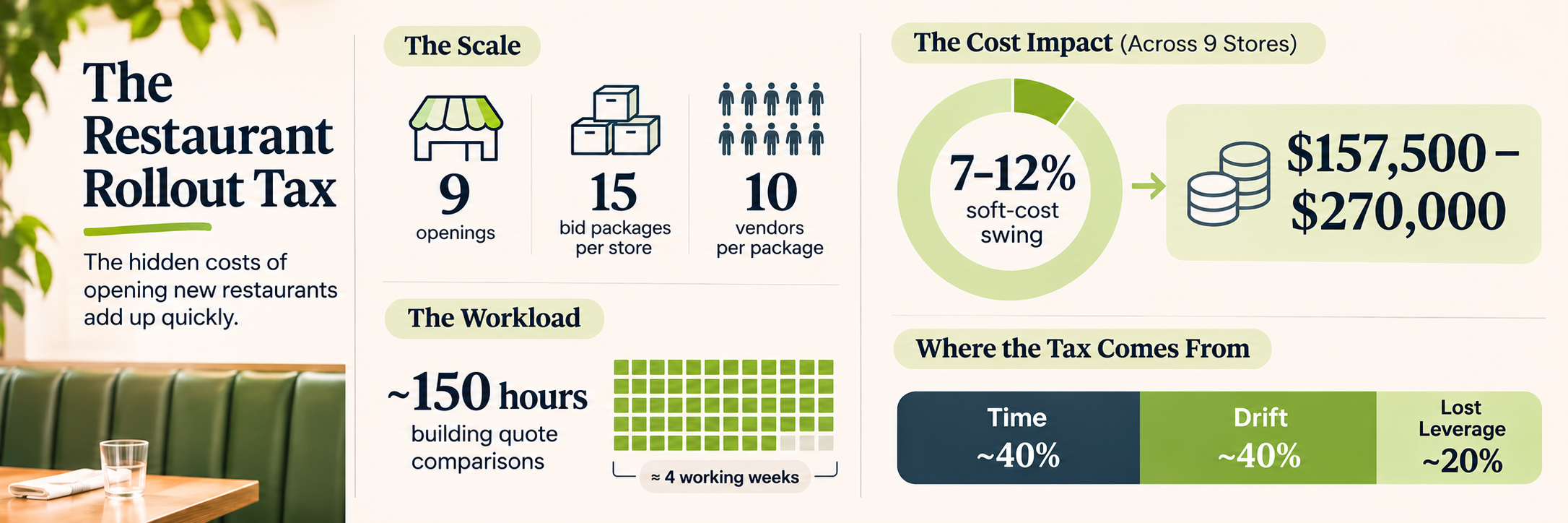
Take the brand above: nine openings this year. Each store's FF&E and equipment buy breaks into about 15 bid packages (refrigeration, cooking line, espresso, seating, lighting, millwork and so on). Purchasing sends each package to 10 vendors, one email at a time.
| Where the tax hides | Per store | Nine stores |
|---|---|---|
| RFQ emails sent | 150 | 1,350 |
| Quote comparisons built by hand (about 100 per project, 10 minutes each) | ~17 hours | ~150 hours, close to four working weeks |
| Soft-cost swing of 7–12% on a $250,000 package | $17,500–$30,000 | $157,500–$270,000 |
| Volume pricing requested across stores | None | None |
The hours are the visible part. Purchasing teams we've talked to describe roughly a hundred side-by-side comparisons per project, about five fields each, three products at a time, color-coded by hand. Only about half of vendors will use a portal, so the rest of the quotes arrive as PDFs, screenshots and phone photos that someone has to retype.
The soft-cost line is the expensive part. Freight, tariffs and import fees commonly add 7% to 12% on top of product price, and they move between quote and shipment. A comparison that ranks vendors on product price alone can pick the quote that ends up costing more delivered.
One caveat on timing. The 2025 federal budget law restored a 100% first-year deduction for qualifying equipment, which, as Back of House notes, frees up cash for multi-unit operators. Talk to your tax advisor about what qualifies. Either way, a deduction lowers the after-tax cost of the cooler. It does nothing for the 150 emails it took to buy it.
What breaks when bids live in inboxes?
The math above assumes everything goes right. Three things usually don't.
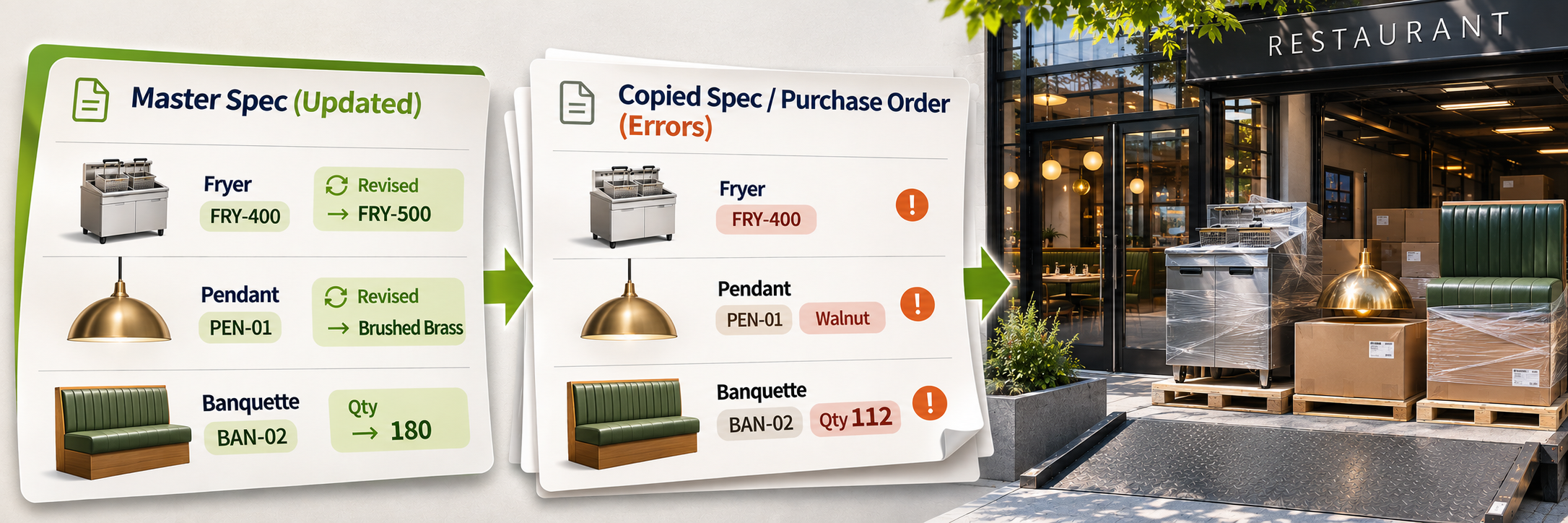
The vendor quotes the wrong spec. Ten emails means ten copies of the spec, and the day design swaps a fryer model, nine of them are out of date. Somebody catches it at the order confirmation, if they check. If they don't, the wrong unit ships to a store where the hood was sized for the right one. Brands that keep their master spec in spreadsheets duplicated per concept run into this constantly: a change in one copy never reaches the others.
The order goes out late. Restaurant rollouts are planned backward from opening day, and the long-lead items are almost always back of house: custom espresso and juice machines, walk-ins, hoods. When the design-to-purchasing handoff runs through email and meetings, a package that sits in someone's inbox for a week becomes a rush order, then an expedite fee, then a store that opens with a rental unit.
Nobody can answer the simple question. "How many times have we bought this pendant across projects in the last six months?" It sounds trivial. In a brand buying store by store, the answer lives in nine POs, three inboxes and one person's memory. Without it, there's no volume conversation with the vendor and no way to spot that two regions are paying different prices for the same item.
There's a dry irony in all of this. Brands buy store by store because each opening feels like its own project. The vendor sees nine identical orders and prices them like nine strangers.
Who should own each step when there's no ERP?
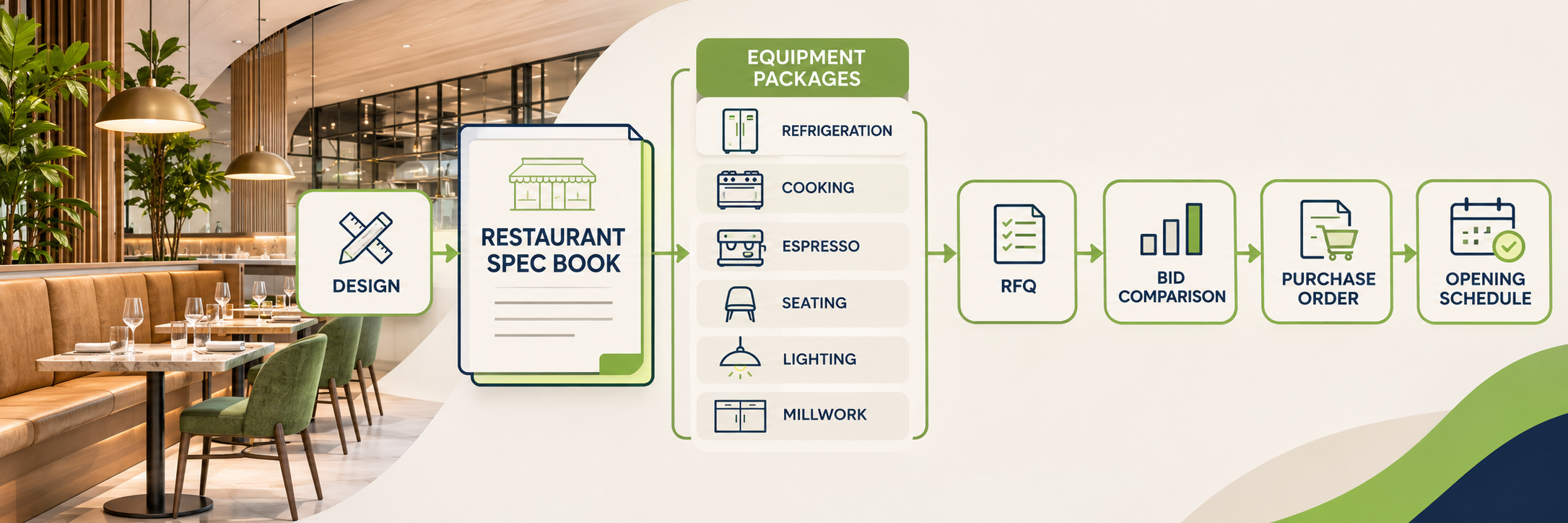
Four roles, each with one document they're accountable for. Most brands between 10 and 50 locations already have these people. What they lack is a clean line between them.
- Design owns the master spec. Every item, its approved alternates and its revision date. Purchasing never bids from a forwarded email or an old spec book, only from the current master.
- Construction or the project manager owns the project budget and schedule. That includes the opening date every long-lead item is planned back from, and which items the GC buys versus which the brand buys. GC-supplied items still count against the budget, so they belong on the same list.
- Purchasing owns the bid and the PO. One RFQ per package to every qualified vendor, one comparison that includes freight and duties, one PO from the winning bid. Then expediting. One multi-brand restaurant group we've worked with drafted its cadence as a first check three weeks after PO release, monthly until four to six weeks before install, then weekly.
- Finance owns budget versus actual. Committed cost at PO release, actual cost at invoice, and the gap explained before close-out rather than after.
The rule that holds it together: nothing gets re-typed. The spec becomes the RFQ, the winning bid becomes the PO, the PO becomes the line Finance reconciles. Every re-entry is a place for a model number to change and nobody to notice.
Should you fix purchasing first, or standards first?
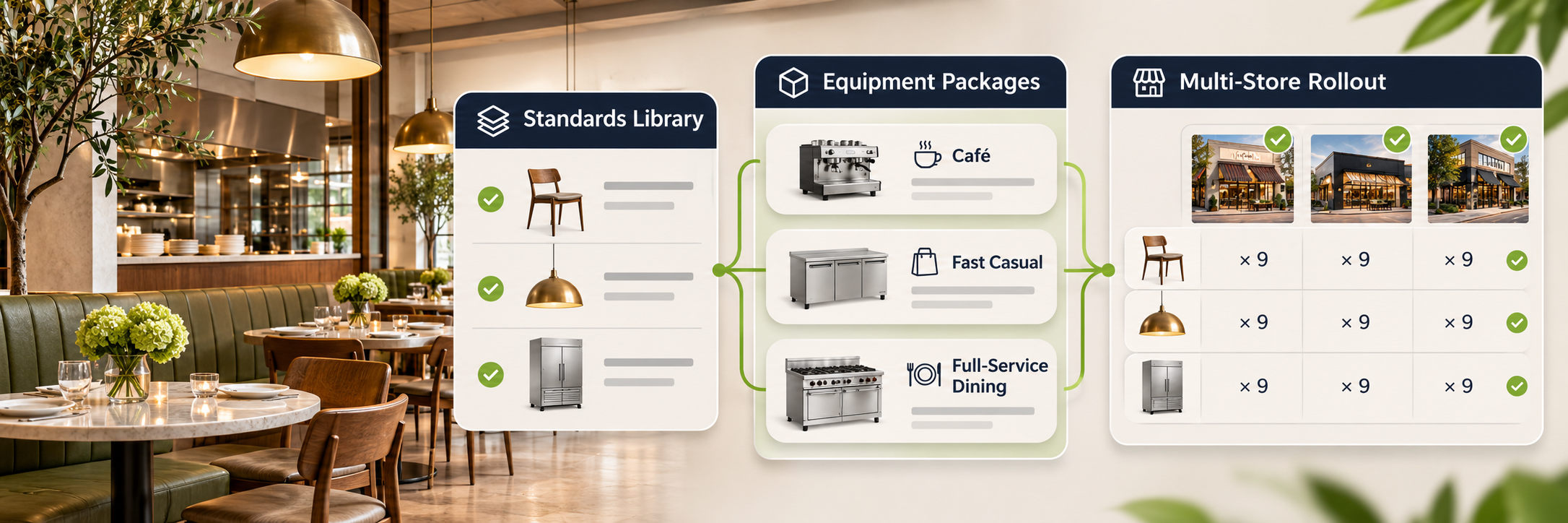
It depends on how many stores you run and what already sits behind your POs. The rollout tax is charged in a different place at each size.
| Where you are | Where the tax lands | Fix this first |
|---|---|---|
| Fewer than about 30 stores in the pipeline, no plan to grow 2–3x | Mostly time, and still manageable | A single bid template and a single comparison sheet that includes freight. A spreadsheet can carry you here |
| 10 to 50 locations, 30+ in the pipeline or growing 2–3x, no robust ERP | Time, soft-cost drift and lost leverage, all at once | The buy itself: one RFQ to every vendor, one comparison, a PO from the winning bid, and a cross-store view of what you're buying |
| Hundreds of locations, ERP in place | Upstream, before the PO exists | The standard: one master spec and equipment packages by restaurant typology, so what reaches the ERP is right the first time |
The middle row is where the tax compounds fastest. A brand that just took new money and announced a big rollout often doubles its openings before it changes how it buys. Each new store adds another round of 150 emails to a process that was designed for five.
The bottom row is a different problem. A brand with hundreds of stores already has procurement software and doesn't want another place to issue POs. Its leak is the spec: regional teams and outside consultants working from different copies, and discontinued items relayed by hand mid-rollout. For those brands, the place to start from the standard is a governed library, with POs staying in the ERP.
What does buying without the tax look like?
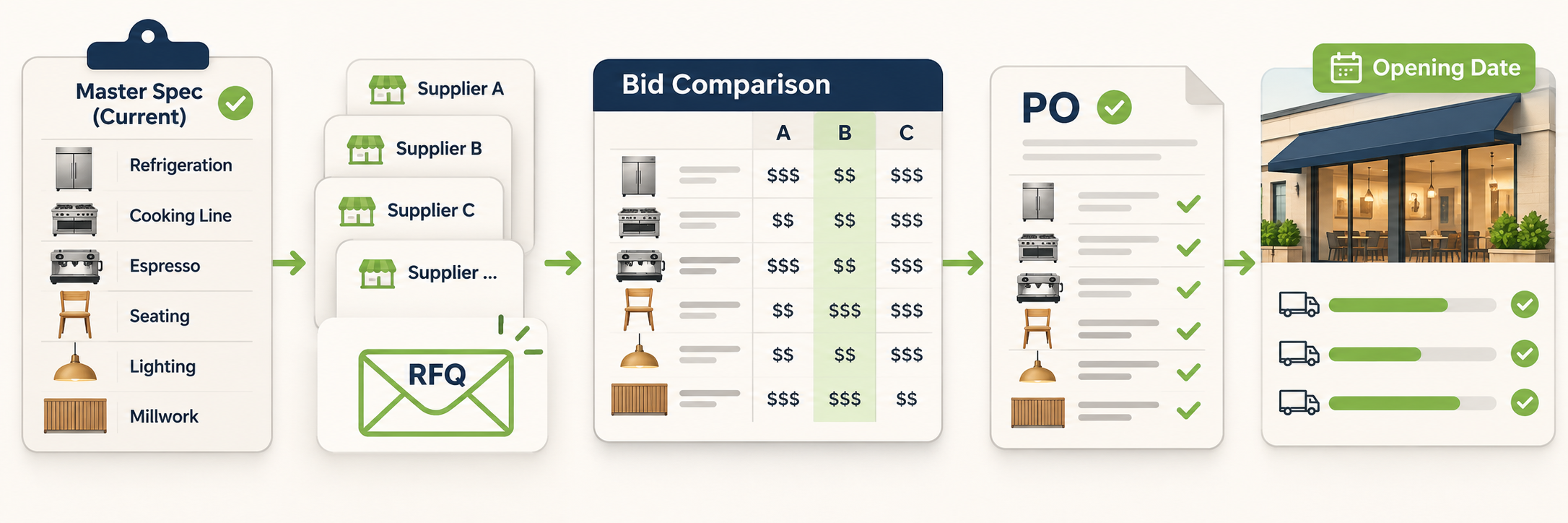
The walk-in cooler again. Purchasing sends one RFQ for the refrigeration package to all ten vendors from the current master spec. Vendors who'll use a portal enter their prices directly. For the ones who send a PDF or a phone photo, someone enters the quote once, and it lands in the same comparison. Price, lead time in weeks and freight sit side by side. The winning bid becomes the PO without retyping, and the order is tracked against the opening date.
That's the workflow Fohlio is built around for in-house purchasing teams: one RFQ, one comparison, with digital and manually entered quotes in one tender table, POs issued from the winning bid, shipments tracked against the schedule, and invoices reconciled against the PO. Cross-project reporting shows what the brand is buying across every store in the pipeline, which is the number you bring to the volume conversation. Brands with an ERP can keep their POs there and use Fohlio for the standards library and the spec that feeds it.
Before your next opening, check these
- Can you name the one document every RFQ is sent from?
- Does your bid comparison include freight, tariffs and import fees, not just product price?
- Do you know which vendors won't use a portal, and who enters their quotes?
- Is every long-lead item planned back from the opening date, with a named owner?
- Can you answer, in five minutes, how many of your top 20 items you'll buy across the pipeline this year?
If the last answer is no, that's the rollout tax, and it's the easiest one to stop paying. Book a demo and bring the spec you emailed ten times last week.
Restaurant rollout procurement: common questions
What is the restaurant procurement process for a new store?
It usually runs from master spec to project spec and budget, then approvals, requisition, RFQ, purchase order, vendor production, delivery, receiving and install, and finally budget-versus-actual close-out. Long-lead items such as custom equipment and walk-ins are planned backward from the opening date.
What hidden costs do restaurant rollouts carry?
The biggest are staff time spent sourcing and comparing quotes, soft costs like freight, tariffs and import fees that change between quote and delivery, rush and expedite fees from late orders, and volume discounts missed because purchases are made store by store.
How much do freight and import fees add to restaurant FF&E and equipment?
Purchasing teams commonly see freight, tariffs and import fees add 7% to 12% on top of product price, and the figure can move between quote and shipment. Compare vendors on delivered cost, not product price alone.
When does a restaurant brand need procurement software instead of spreadsheets?
A common threshold is more than about 30 locations in the pipeline, or plans to grow two to three times. Below that, a disciplined spreadsheet process often works. Above it, the time and errors from emailing specs and retyping quotes grow with every store.
Should a restaurant brand with an ERP use a separate procurement tool?
Usually not for POs. Brands with hundreds of locations tend to keep purchase orders in their ERP and focus on the upstream problem: a single master spec and equipment packages that keep what reaches the ERP accurate.
What should a restaurant RFQ include?
The current spec and model number, approved alternates, quantity per store and across the pipeline, required delivery date, delivery location, and a request to quote freight and lead time in weeks separately from product price.


