
Most store rollouts don't fail on opening day. They fail weeks earlier, when a design revision is approved and the procurement team never sees it.
In mid-upper retail, every store is a custom project. Fitting-room seating is upholstered to order. Millwork is built for one footprint. Fixtures come from artisan suppliers in Italy, Portugal, or Asia who work to the organization's drawings, not a catalog. Each approved design change has to become a revised shopping list. Until it does, procurement is buying against yesterday's spec.
Why specs change so often in retail
Luxury and premium retail brands sell an experience as much as a product. The fitting room, the lighting, and the finish on a display table carry the brand's identity, so design teams revisit them constantly.

Several forces keep specs moving after the first issue:
- Layered approvals. A custom piece may need sign-off from the design manager, the project manager, a local architect, and an executive. Each layer can send it back.
- Leadership and ownership changes. New leadership often arrives with exacting standards and an expansion plan. Decisions made under the previous team get reopened.
- Footprint variation. No two malls offer the same space. A fitting room that holds two sofas in one location needs three in the next.
- Regional adaptation. Local codes, supplier availability, and freight constraints change what can be specified in each market.
None of this is a process failure. It's the normal state of a custom rollout. The failure is when the change stays in a redlined drawing or an email thread.
Long approval chains carry their own risk. Approval Trails for Multi-Team Store Rollouts covers how to keep each sign-off on record.
What the gap costs
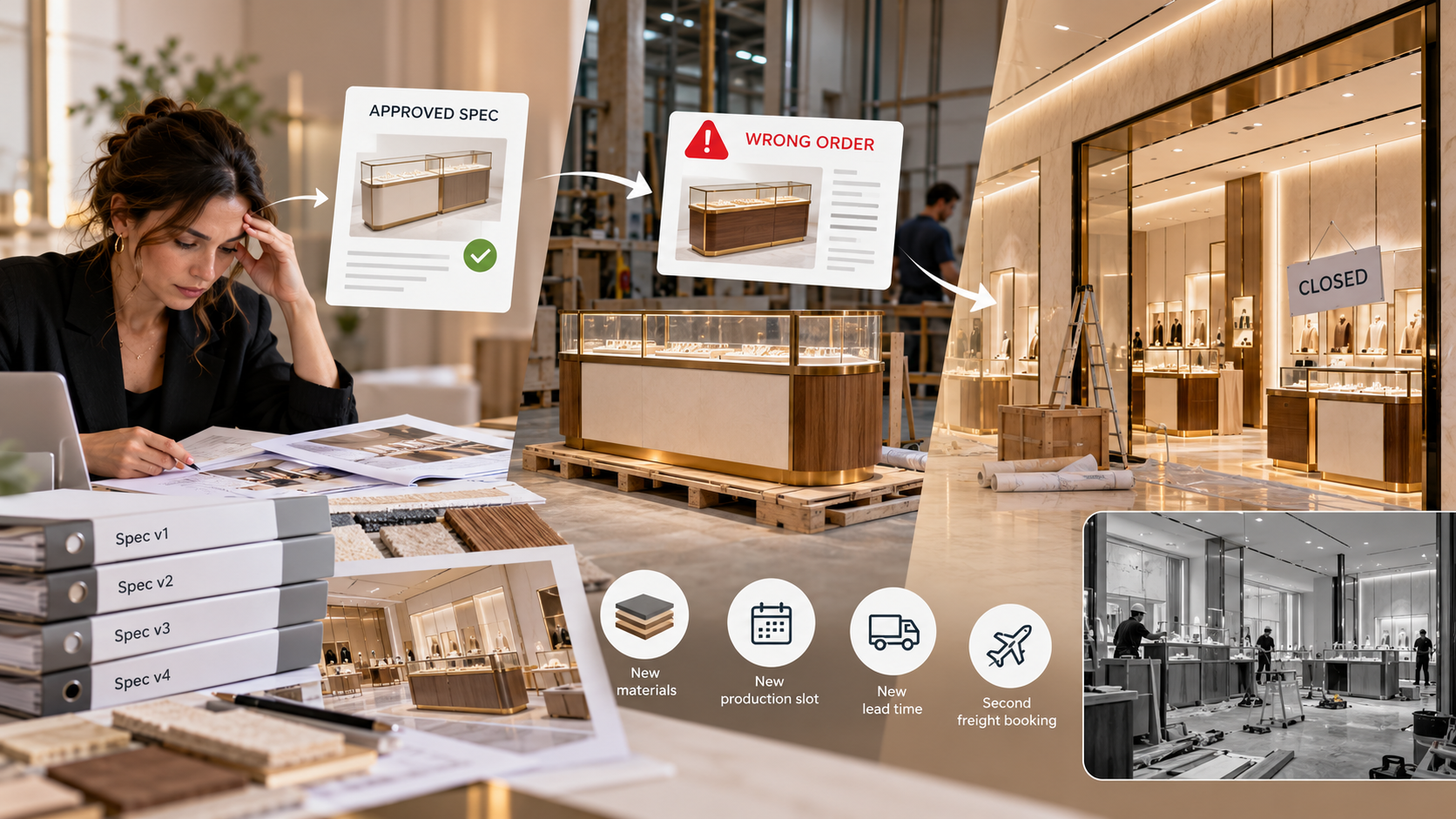
When procurement places a PO against an outdated spec, the cost is rarely a returned box. With custom fabrication, a wrong order means new material, a new production slot with the fabricator, a new lead time, and often a second freight booking.
The worst case is a store that opens off design intent. One global luxury jewelry house completed a store that did not match what the design team had specified. The organization closed it and rebuilt it, effectively paying for the same project twice.
The quieter costs add up too:
- Designers spend hours turning approved specs into shopping lists for procurement.
- Teams reconcile spreadsheet versions before every supplier call.
- Approval disputes resurface because no one can show which version was signed off, or when.
Live data, not more communication
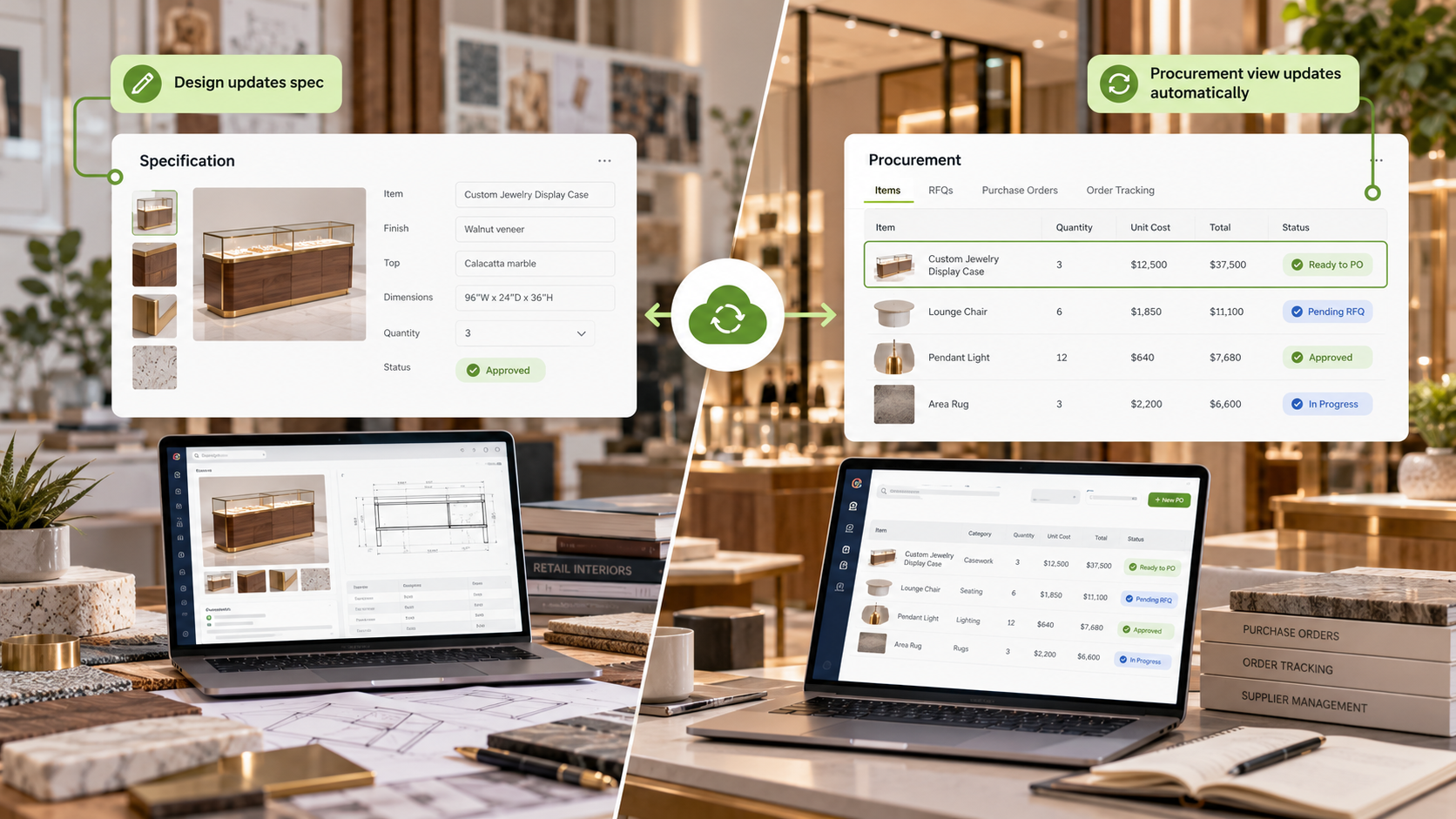
The usual fix is more communication: another status meeting, another email chain, another tracker. Each one adds lag between the moment a change is approved and the moment procurement acts on it.
The better model removes the handoff. Design and procurement work from the same specification record. When a revision is approved, the procurement view updates with it, including recalculated quantities. No one has to send anything.
A senior procurement leader who came up through a European luxury group described what large retail organizations want as "centralized control and visibility." That means control over what gets specified and approved, and visibility into where every item stands across locations and project stages.
What a working handoff looks like
An organization running a multi-store rollout should be able to:
- Work from one spec record. Design and procurement see the same item, the same version, and the same approval status.
- Roll up shared materials. When one fabric covers a sofa, an ottoman, and a bench across 12 stores, procurement sees total yardage per supplier, not three separate line items per store.
- Lock specs after ordering. Once an item is on a PO, changes should require a deliberate unlock, so a late edit can't slip through unnoticed.
- Answer "who changed this, and when?" Every revision carries a name, a date, and the prior value.
- Forecast for suppliers early. Current specs, multiplied across the store pipeline, tell artisan suppliers what's coming months before the PO.
Early supplier forecasts depend on a budget built from the bottom up, not from last year's average. Store Rollout Budgets Beyond 'Last Year × 25' walks through how to build one.
Questions to ask your team
If you're unsure where your own handoff stands, these questions usually surface the gap quickly:
- When design changes a spec today, how does procurement find out, and how long does it take?
- Can procurement see the full purchasing volume for a fabric or finish across every open project?
- If an item was ordered wrong last quarter, could you trace which version it was ordered against?
- How many hours a week do designers spend preparing lists for procurement?
Where Fohlio fits
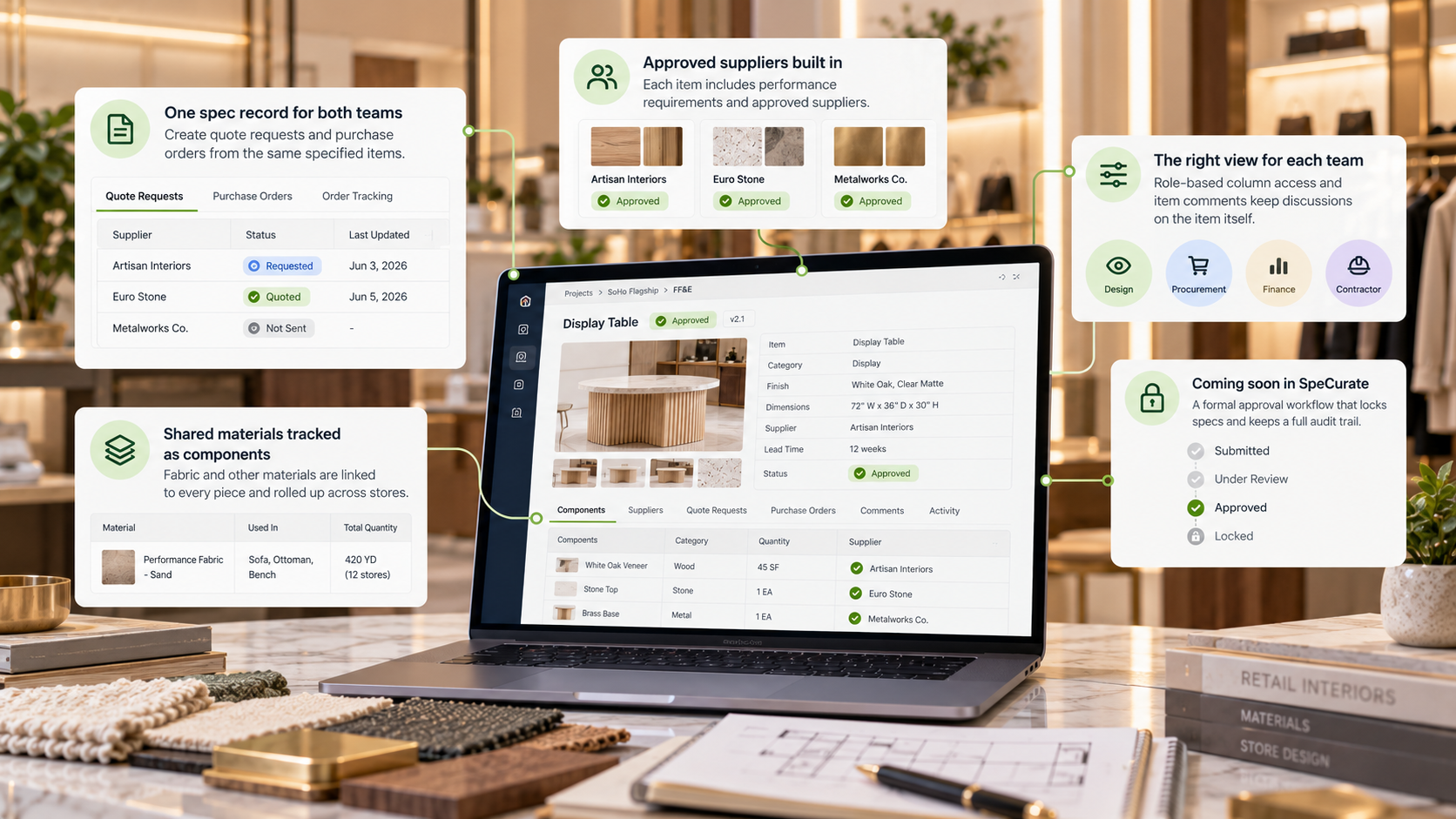
Fohlio keeps FF&E specifications, brand standards, and approved-supplier collections in one system that design and procurement teams share across every location. Here's how that maps to the handoff:
- One spec record for both teams. Quote requests and purchase orders are created from the specified items on the project sheet, so procurement orders against the current spec instead of a copy.
- Approved suppliers built in. Collections pair each item with its performance requirements, a reference product, and the suppliers approved to make it.
- Shared materials tracked as components. Fabric and other materials are linked to every piece that uses them, and Cross Project Reports roll items up across stores.
- The right view for each team. Role-specific column access controls who sees and edits which fields, and item comments keep the discussion on the item itself.
- Coming soon in SpeCurate: a formal approval workflow that locks specs once approved and keeps a full audit trail of who changed what, and when. SpeCurate is Fohlio's next-generation specification and procurement platform.
If your rollout runs on spreadsheets and email, book a demo to see how retail organizations keep design intent intact from first spec to final install.


