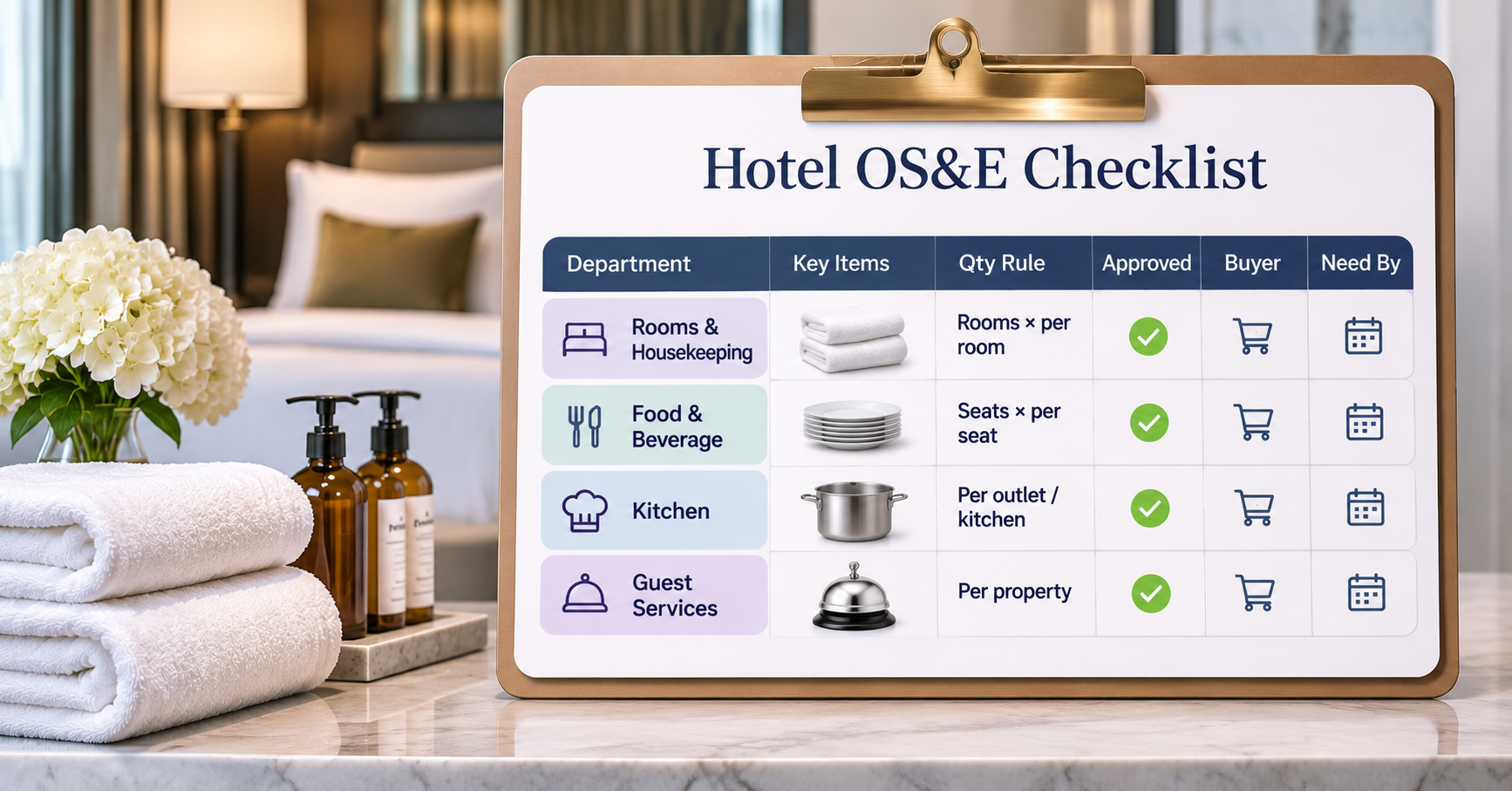
Six days before opening, the director of housekeeping at a 250-key hotel counts the linen room. Every nightstand and lounge chair arrived weeks ago, each with a PO number and a tracking link. The bath towels cover one change per room, not three. Somewhere in the fourth version of the hotel OS&E checklist, passed between the brand, the owner's purchasing team and five department heads, a "3" became a "1," and nobody can say who typed it. The hotel ran its furniture through a procurement system and its operating supplies through a file.
A hotel OS&E checklist is the department-by-department list of operating supplies and equipment a property needs to open: linens, guestroom supplies, tabletop, kitchen equipment, uniforms and back-of-house tools. A useful one also records how each quantity was set, who approved it, who buys it and when it must arrive.
Why does OS&E end up in a spreadsheet when FF&E doesn't?

Because the two are bought by different people, on different budgets, in different units.
FF&E (furniture, fixtures and equipment) is usually a capital purchase. A designer specifies it, a purchasing agent or the owner buys it, and it's tracked item by item because a single custom sofa can cost thousands and take months. OS&E (operating supplies and equipment) is a pre-opening purchase that then turns into a recurring operating expense. It's bought by operations teams, a hotel procurement director or the owner, often from commercial distributors, and it's counted by the dozen, the case and the pack. For the full breakdown of the two, see our comparison of FF&E vs OS&E.
That difference pushes OS&E into Excel. A full-service hotel's opening list runs to hundreds of lines, most of them cheap on their own, so nobody feels they deserve a system. Yet those lines carry more decisions per dollar than any chair: a par level, a pack size, a brand standard, a department's sign-off and a delivery window. A spreadsheet can hold the numbers. It can't hold the reasons behind them.
There's a second split that makes it harder. On many branded projects the brand guides and the owner buys. The brand's pre-opening team drafts the list from its standards, but the owner places the orders, can swap items and can use their own suppliers. The brand is responsible for an outcome it can't see.
What goes on a hotel OS&E checklist, department by department?
Organize the checklist the way the hotel will run, by department, not the way a supplier catalog is laid out. Each department head reviews only their section, and each section has one name at the top.
| Department |
Typical OS&E categories |
Usual unit |
Who signs off |
| Rooms and housekeeping |
Bed and bath linen, pillows and protectors, bathrobes, in-room amenities, hangers, in-room coffee equipment, housekeeping carts, laundry supplies |
Case, pack, each |
Director of housekeeping |
| Food and beverage (front of house) |
Chinaware, glassware, flatware, table linen, buffet and banquet equipment, bar tools, menus and holders |
Dozen, case |
Director of F&B |
| Kitchen (back of house) |
Cookware, smallwares, sheet pans, storage, small electrics, cleaning and sanitation equipment |
Each, case |
Executive chef |
| Front office and guest services |
Key cards, luggage carts, umbrellas, guest-facing stationery, lobby supplies |
Each, pack |
Front office manager |
| Engineering and security |
Tools, spare parts, safety equipment, radios, first-aid supplies |
Each |
Chief engineer, director of security |
| Recreation, spa and fitness |
Pool towels, lounger cushions, spa linen and consumables, fitness accessories |
Case, each |
Spa or recreation manager |
| Administration and team |
Uniforms by role and size, back-office supplies, team dining equipment |
Each, by size run |
Director of human resources |
Two lines sit across every department: leased equipment (some kitchen and laundry equipment is rented rather than bought, which changes who installs and tests it) and items the brand mandates, which a department can't swap without approval. Mark both on the list from day one.
How do you set OS&E quantities without guessing?
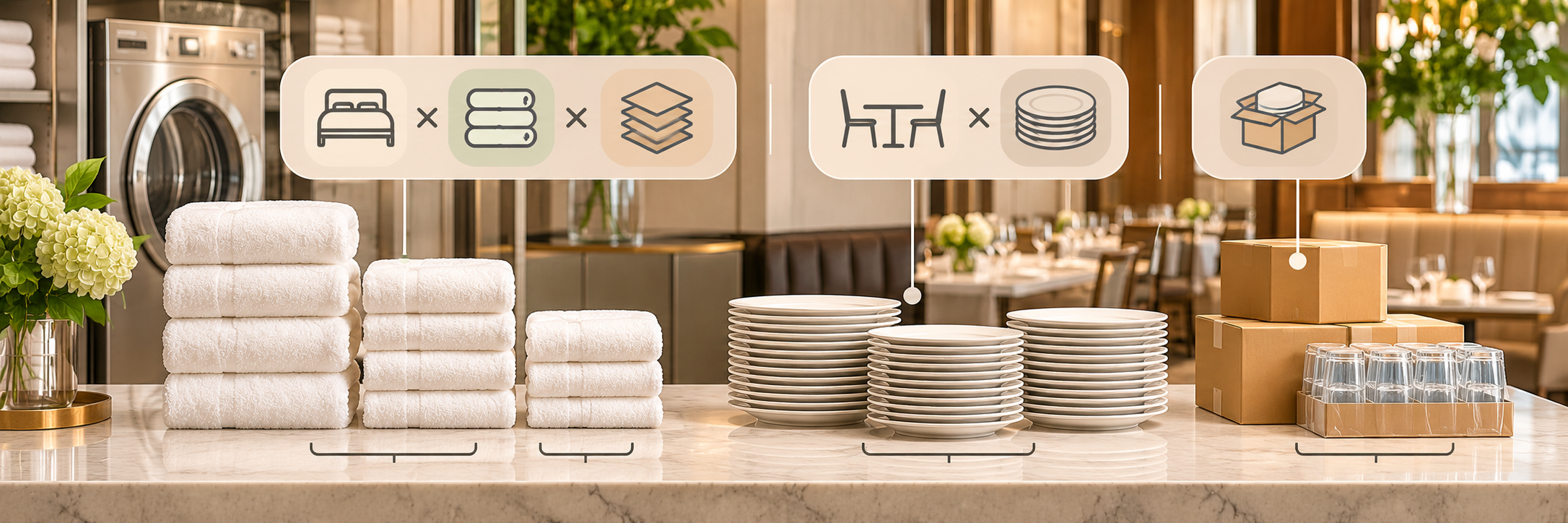
Every quantity should come from a rule you could explain to a stranger, not from last year's file.
Take bath towels as a worked example. A 250-key hotel plans four bath towels per room. Housekeeping needs one set in the room, one in the laundry and one on the shelf, which is a par of 3. That's 250 × 4 × 3 = 3,000 bath towels. If the supplier ships them in packs of 12, the order is 250 packs, and the purchase quantity, the operating quantity and the stock you hold for loss and damage are now three different numbers. Most opening shortages start when someone compares two of them as if they were the same.
The same arithmetic applies to tabletop, where the unit is usually the dozen. A 120-seat restaurant that plans three dinner plates per seat needs 360 plates, or 30 dozen. Order "360" from a supplier who prices by the dozen and you'll either get a confused acknowledgment or 4,320 plates.
Three habits keep the numbers honest:
- Write the rule next to the quantity. Rooms × per room × par, seats × per seat × par, or headcount × sizes for uniforms. When the room mix changes, the quantity changes with it instead of waiting for someone to notice.
- Keep spec, purchase and stock quantities in separate columns. Pack rounding and extras belong in the purchase quantity, not hidden in the spec.
- Record the unit of measure on every line. DOZ, CASE, PACK or EA. It's the cheapest error to prevent and one of the most common to find on delivery day.
Who owns each step of pre-opening OS&E?
Pre-opening OS&E is a relay, and the baton drops at the handoffs. On a branded opening or takeover, the stages usually run like this:
- Project information. Design or development hands over room counts, the room mix, outlet seat counts and renders. Owner: the project or development lead.
- Theoretical OS&E list. The brand's pre-opening OS&E lead drafts the list from the brand's standard list and the project information. It's the basis for the OS&E budget. Owner: pre-opening OS&E lead.
- Operations review. Each department head reviews and adjusts their section to the property's needs. Owner: department heads, one per section.
- Purchasing. The approved list goes to the owner or their purchasing agent, who places orders, sometimes through brand agreements and sometimes with their own suppliers. Owner: owner's purchasing lead.
- Purchasing control. Someone checks that every line was ordered on time, follows up with suppliers and confirms substitutions against the standard. Owner: should be named in writing; often it's nobody.
- Receiving and hand-down. Goods are received, counted against the purchase quantity, and formally handed to the hotel team with installation and testing where needed. Owner: the hotel's receiving lead and department heads. Our guide to receiving, inventory and installation covers this stage in detail.
- Opening record. The final list of what was actually bought, in what quantity, from whom, is handed to operations. It becomes the baseline for replenishment.
Step five is the one most teams leave unassigned, and step seven is the one most teams never produce. Both matter more than they look. Without step five the brand finds out about a substitution at the inspection. Without step seven the next property's list starts from a guess again.
Where does a pre-opening OS&E list usually break?
It starts from the last hotel's file. Someone copies the previous opening's spreadsheet because it's faster than starting from the standard. The new hotel has a different room mix, a second restaurant and no spa, but the list carries spa robes and the old seat count anyway. The fix is to start every list from the brand's standard list plus this project's numbers, never from another property.
A quantity changes during review and nobody knows why. Department review is where a list gets better, and where it quietly breaks. When everyone edits their own copy, a required brand item can be zeroed, a par can drop from 3 to 1, and the master list never hears about it. Every change during review needs three things recorded: who, what and why.
The brand can't see what the owner bought. Once the list goes to the owner, it leaves the brand's hands. The owner may change a supplier for good reasons, or swap a mandated item for a cheaper one. If owner changes don't come back to the master list, the brand learns at the pre-opening inspection, when the only fix is an expedited order.
The record ends at opening day. The hotel opens, the spreadsheet is archived, and replenishment starts from whatever the storeroom holds. Brands running several openings a year tell us the same thing: looking back across the last five projects means sifting through spreadsheets by hand, so the lessons never make it into the next list.
If OS&E sits inside a larger renovation, the same handoff problems show up across the whole FF&E and OS&E procurement workflow, and they're worth fixing in one place.
What should a hotel OS&E checklist record for every line?
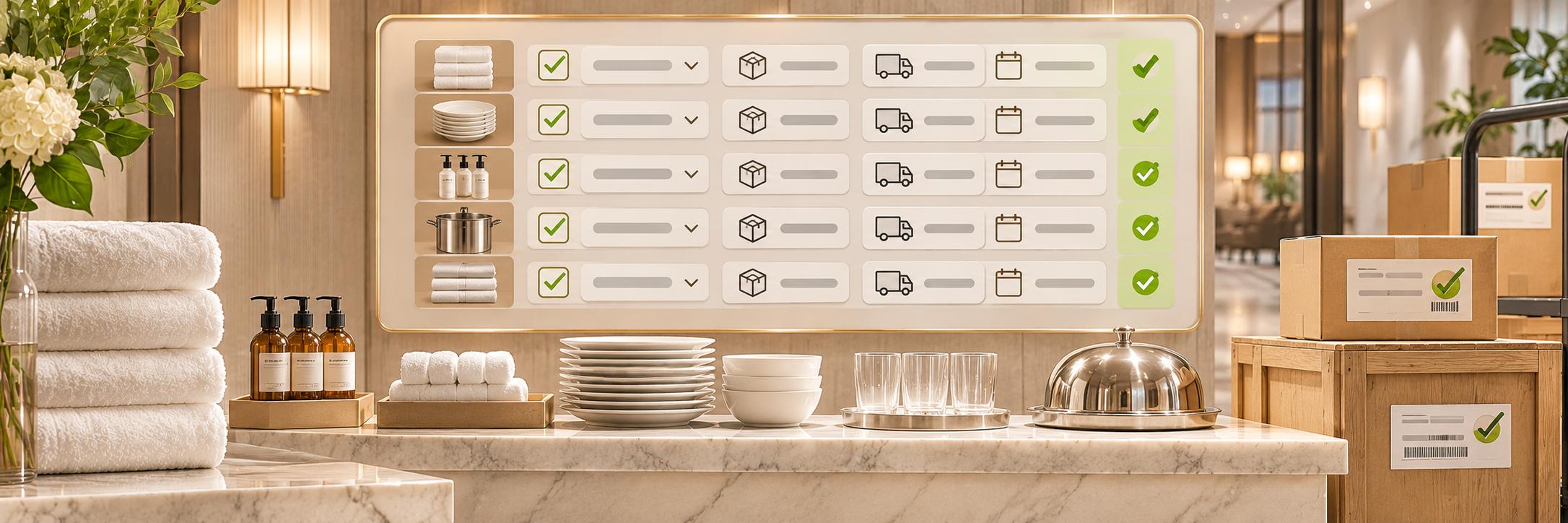
Here's the short version to paste into your next pre-opening template. If a line is missing any of these, it isn't ready to order.
- Department and category
- Item, with a link to its specification or brand standard
- Mandatory brand item or department choice
- Quantity rule (rooms, seats or headcount × per unit × par)
- Spec quantity, purchase quantity after pack rounding, and opening stock
- Unit of measure: DOZ, CASE, PACK or EA
- Supplier and whether it's a brand agreement or owner-sourced
- Approver and approval date
- PO number, order status and required-on-site date
- Received quantity and the name of whoever counted it
The rule underneath it: if a quantity can change, it needs a name and a reason next to it. That single habit catches most of what goes wrong in the last two weeks before opening.
Where Fohlio fits
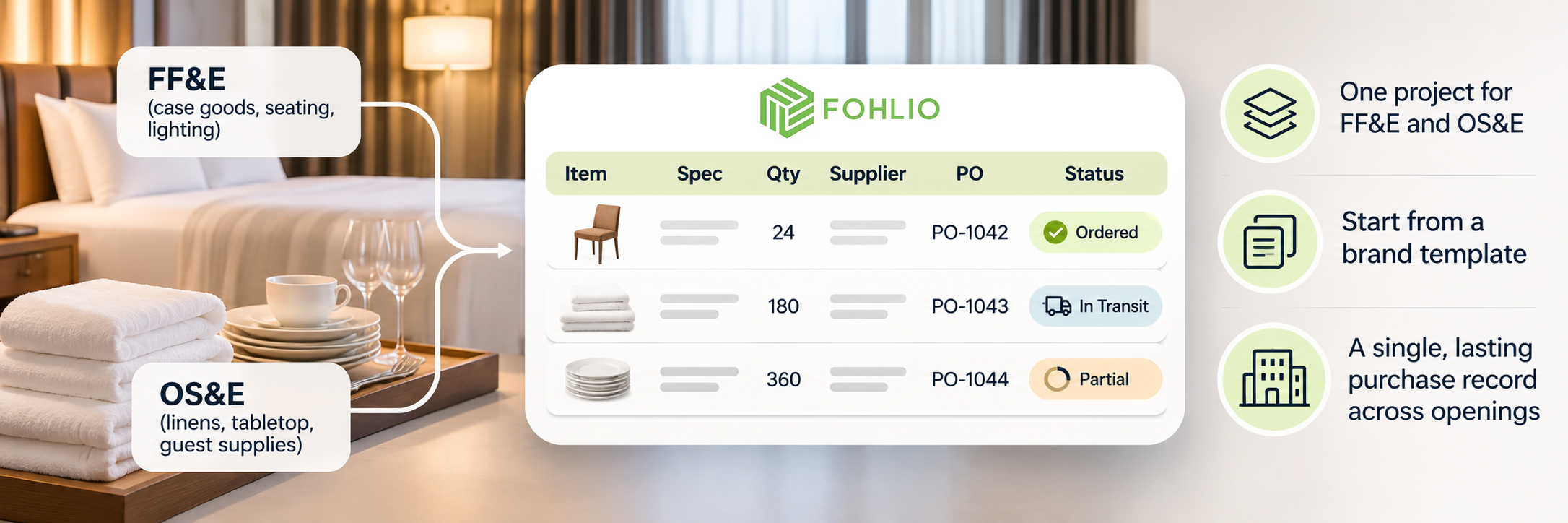
Fohlio keeps OS&E in the same project as FF&E, so linens and tabletop get the same treatment as case goods: each line with its specification, quantity, supplier, purchase order and order status, visible to the brand, the owner's team and the department heads who need it. Teams that open more than one property start each list from a brand template instead of from the last hotel's file, and the purchased record stays in place for the next opening. Brand standards teams managing OS&E standards across a portfolio can also see how standards changes reach live projects in our piece on hotel brand standards compliance from SpeCurate by Fohlio.
Planning an opening for next year? Book a demo with SpeCurate by Fohlio and bring your current OS&E spreadsheet. And if your design partners are starting to use AI on specifications, join our free 30-minute webinar on December 8, The AI Handoff: What Owners Should Expect From Their Design Partners.
Hotel OS&E checklist: common questions
What is a hotel OS&E checklist? It's the list of operating supplies and equipment a hotel needs to open, organized by department: linens, guestroom supplies, tabletop, kitchen equipment, uniforms and back-of-house tools. A good one records each item's quantity rule, unit of measure, approver, supplier and delivery date, not just the item name.
What is the difference between FF&E and OS&E in a hotel? FF&E is furniture, fixtures and equipment such as case goods, seating and lighting, usually bought from capital or renovation budgets. OS&E is operating supplies and equipment such as linens, tableware and amenities, bought for pre-opening and then replenished from operating budgets.
Who is responsible for pre-opening OS&E? It's usually shared. On branded hotels, the brand's pre-opening team drafts the list from its standards, department heads review their sections, and the owner or a purchasing agent buys the items. Someone should be named to check that everything was ordered on time and matches the standard.
How do you calculate OS&E quantities for a hotel? Multiply the driver by the amount per unit and the par level. For example, 250 rooms × 4 bath towels per room × a par of 3 = 3,000 towels. Then round to the supplier's pack size and keep spec, purchase and stock quantities in separate columns.
When should a hotel start its OS&E list? As soon as the room count, room mix and outlet seat counts are reliable, because the list drives the OS&E budget. Waiting until construction is nearly finished leaves too little time for custom items, uniforms and brand-mandated products to arrive before opening.