
The owner asks the question on the first call, before the PIP document is even open: "Ballpark, what's this going to cost me per room?" The purchasing agent gives the answer every experienced agent gives. "It depends." The owner hears a dodge. The agent knows it's the only honest answer they have yet.
Both are right, and the gap between them is where PIP budgets go wrong.
Short answer: there is no reliable single hotel PIP cost per room, because a property improvement plan prices the gap between your building and the brand's current standard, not a fixed scope. Published per-key figures differ by tier, year, region and what they include. Use them as a range to sanity-check, then build your own number bottom-up from the PIP list, the building's condition and soft costs.
Why won't anyone give an owner a hotel PIP cost per room?
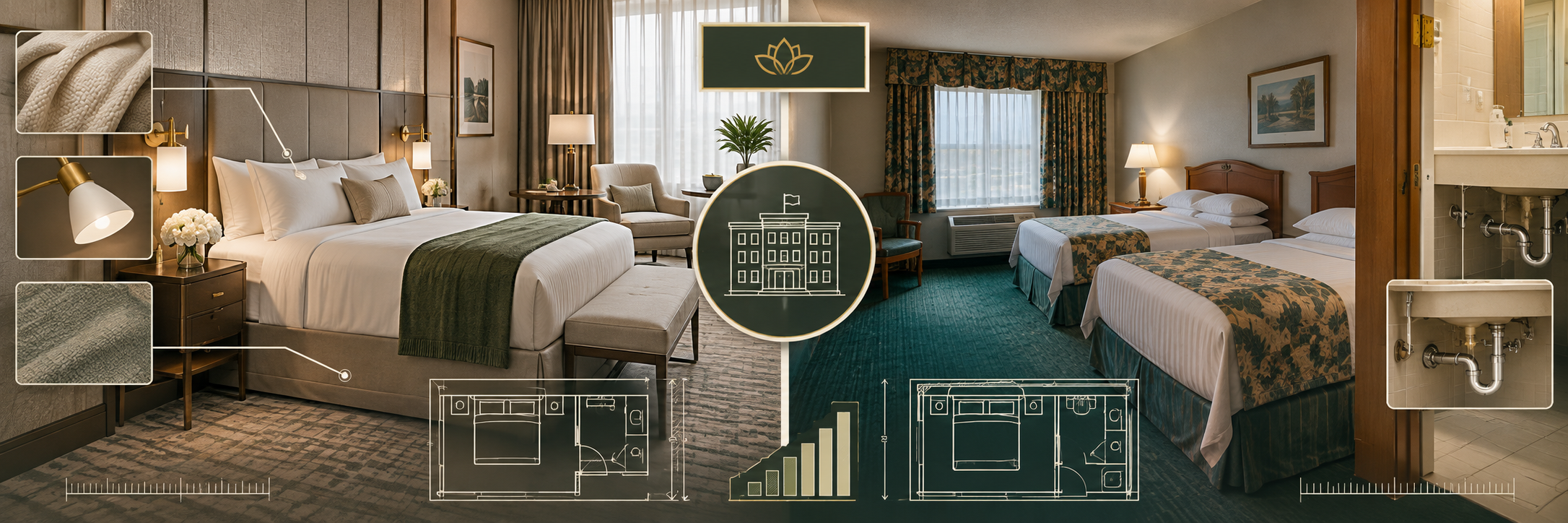
Because the number belongs to the building, not the brand.
A PIP is the list of work a brand requires to bring a hotel up to its current standards, usually triggered by a sale, a franchise renewal or a conversion. Two hotels under the same flag can get PIPs that read almost the same and cost very different amounts. One was renovated four years ago and needs soft goods and lighting. The other was last touched when the carpet pattern was still teal, and its PIP quietly implies new bathrooms, because the brand's vanity standard won't fit the existing plumbing.
The brand standard doesn't help as much as owners expect. Many standards describe performance rather than products: "non-porous natural stone, not slippery," not a SKU with a price. That's good for design freedom and bad for a quick estimate. Nobody can price a sentence until a designer turns it into a specification.
And the standard itself moves. Brands revise standards anywhere from twice a year to every few years, and new projects get the latest version. The per-room figure a peer quoted you from their PIP two years ago may have been priced against a different book.
What actually drives the cost of a PIP?

Five things move the number more than the brand name does.
The building's age and layout. Brand standards are written for the brand's current prototype, not for a 1987 floor plate. Conversions and older buildings fight the standard at every wet wall and corridor width, and each fight becomes either construction cost or a variance request.
The tier. Economy and midscale brands have the widest pool of compliant products and the tightest cost targets. Upper-upscale and luxury brands have fewer qualified suppliers, more custom pieces and longer approval chains.
Partial vs. full scope. A soft-goods refresh (carpet, drapery, bedding, upholstery) is a different animal from a case-goods replacement or a full room with bathrooms. Partial scopes also force a match-or-refresh decision: if the new headboard doesn't work with the existing nightstands, the nightstands join the PIP.
Quantities that aren't the room count. Specified quantity and purchase quantity differ. Tile and carpet carry waste, often 10 to 20% on tile. Appliances and electronics carry a small overage for damage. Attic stock adds spare units. A 200-key hotel never buys exactly 200 of anything.
Soft costs. Freight, duties, import fees, receiving, warehousing and installation sit on top of product cost. Practitioners commonly see 7 to 12% added for shipping and import fees alone, more in some regions, and that slice moves between quote and shipment. Imported upholstered wooden furniture, for example, has carried a 25% U.S. duty since October 2025 under a federal proclamation, with increases scheduled for January 1, 2027.
Why do published PIP cost ranges disagree so much?
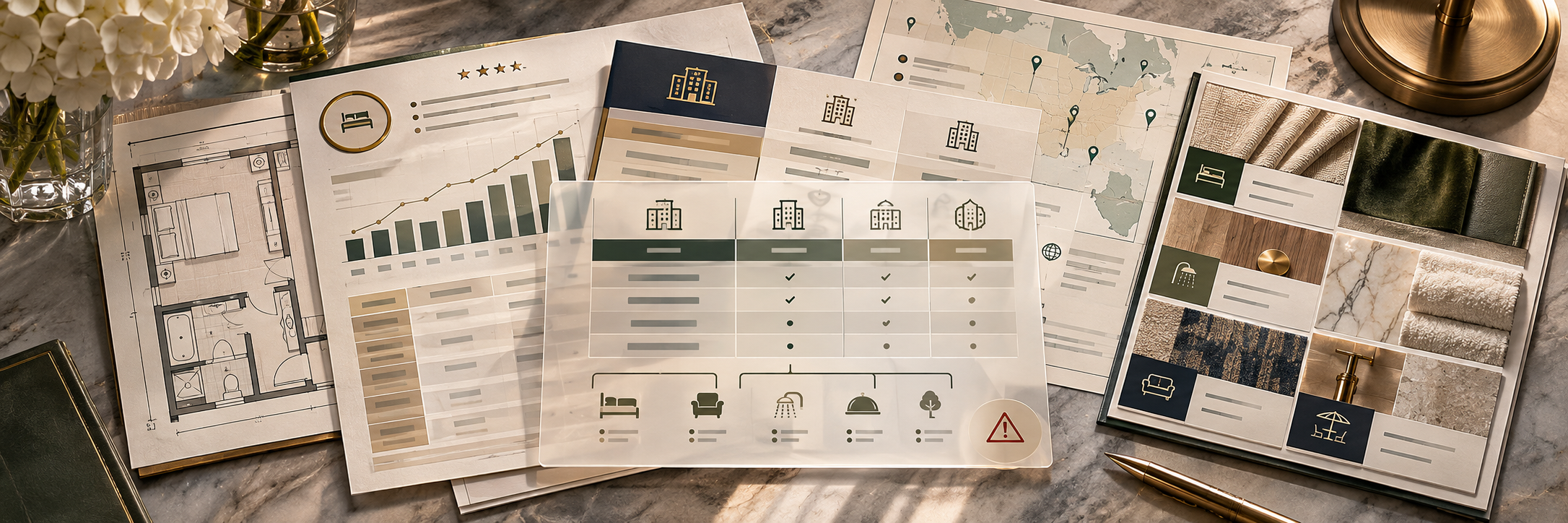
Owners who search for a per-room figure find several sources, and they rarely agree. Annual hotel cost estimating guides publish per-key ranges by segment. Franchise disclosure documents, which U.S. franchisors must give prospective franchisees, include estimated investment ranges that can cover conversions and renovations. Lenders and brokers quote reserve figures. Peers quote what they spent.
Before you compare any two of those numbers, check five things:
- Scope: soft goods only, guestroom FF&E, full guestroom including bathrooms, or rooms plus public space and exterior.
- Unit: per key, per room or per square foot. Suites and multi-bay rooms make "per room" and "per key" diverge.
- Year: a pre-tariff, pre-freight-spike figure isn't today's figure.
- Tier and region: a select-service number in a secondary market says little about a full-service hotel in a gateway city.
- What's excluded: design fees, purchasing fees, soft costs, OS&E, contingency.
A per-key number without its scope line is a rumor with a dollar sign. Ask for the scope line every time.
How do you build a PIP budget that holds?

Experienced purchasing agents build PIP budgets bottom-up, because every hotel is different. The sequence below is the one most branded renovations follow, with the owner of each step.
- Preliminary budget (owner and asset manager). Built from history and proof of funds. Treat it as a ceiling, and note how old the history is. Prices in it may be three weeks or three years old.
- Standards handoff (brand to owner and operator). The brand issues the PIP and the current standards book. Everyone signs the same version.
- Plans check (architect and designer). The designer reads the existing building against the standards and flags where it won't comply without construction.
- Mandatory items first (designer). Specify everything the PIP requires, then the optional items within what's left. One purchasing team's rule of thumb: expect roughly a quarter of the budget to remain for choices once the mandatory list is priced. If it's much less, value engineering starts now, not after bids.
- RFQ and pricing (purchasing agent). Confirm prices, lead times and freight. Lead times in weeks belong in the budget conversation because they decide how long rooms stay out of inventory.
- PO approval (owner and agent). Accuracy check, funding check and a comparison against the budget line by line.
- True spend (agent to owner). Final invoices, not pro formas, become the history the next PIP budget starts from.
What does one change cost across a whole hotel?
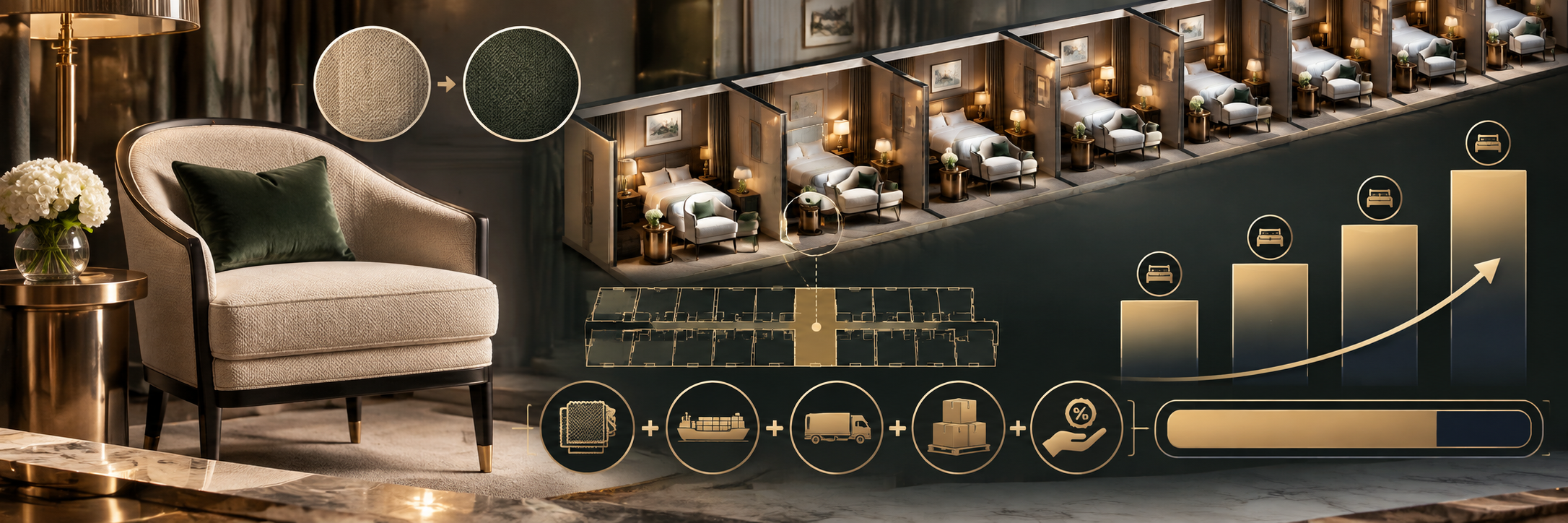
Here's a worked example with round numbers. Say a 150-key hotel's guestroom FF&E package prices at $1.2 million before soft costs.
- Shipping, duties and import fees at 7 to 12%: $84,000 to $144,000.
- A purchasing agent's fee, often a few percent of total value (around 4% is common for agents who charge a flat fee): about $48,000.
- Deposits: suppliers often want 20 to 50% up front, so the owner may need to fund a large share of the package before anything ships.
Now the brand's design review swaps the guestroom chair for one that costs $200 more. Across 150 keys, that's $30,000 before freight or install. On a 400-key hotel, the same swap is $80,000. Nobody made a bad decision; the per-key math just multiplies every small one.
That's why the honest answer to "what does a PIP cost per room" is a range with assumptions written next to it, and a process that updates the number every time an assumption changes.
Where do PIP budgets usually break?
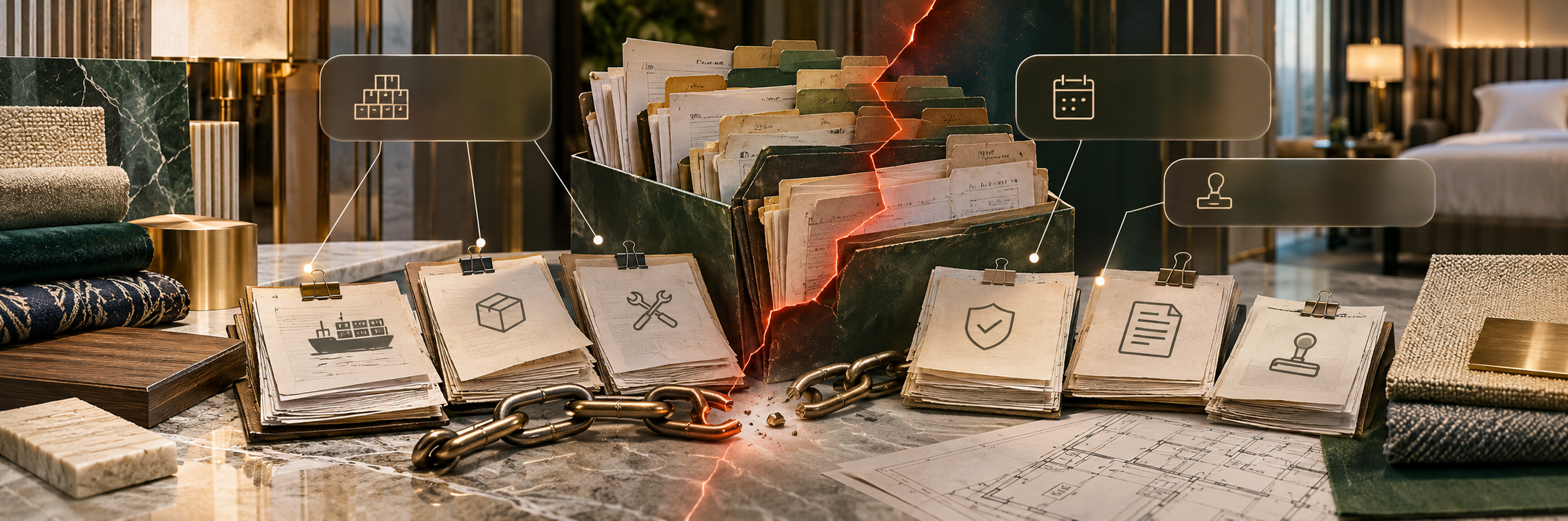
Soft costs rolled into one line. If freight, duties and install sit in one figure, the agent can't show the owner budget vs. actual by category, and can't justify asking for more when freight jumps.
Knowledge that leaves with the consultants. The designer and purchasing agent from the last renovation cycle had the real numbers. If they kept the files, the owner starts the next PIP from scratch.
No dated purchase record. Warranties often run 12 to 24 months from purchase. Without a record of what was bought, when and from whom, owners pay to replace items still under warranty and can't answer "where did we buy this?" when a matching replacement is needed.
Approvals with no trail. Brand, owner, asset manager and designer all sign off on something. When the trail lives in email, the change that blew the budget has no author.
Questions to ask before you accept a PIP number
- Which version of the brand standards is this priced against?
- What's in scope: soft goods, case goods, bathrooms, public space, exterior?
- Is the figure per key or per room, and which year are the prices from?
- Are freight, duties, purchasing fees, OS&E and contingency included?
- Which items are mandatory and which are choices, and what's left after the mandatory list?
- Who will own the budget-to-actual record after the last invoice?
How Fohlio helps owners and agents price a PIP
Fohlio is where many purchasing agents and owner teams keep the PIP specification, budget and orders in one record, so budget, specified and purchased costs can be compared item by item, and POs and invoices stay attached to the rooms they cover. That record is what turns this PIP's true spend into the next one's starting number. See how it works for hotel PIP renovations and renovation procurement and sourcing, or read why the most expensive person on a PIP isn't the designer, how to build a BOQ that survives procurement, and what project closeout data should feed back into the next budget.
Owners standardizing specs across a portfolio can also see SpeCurate by Fohlio for owners and operators. Book a demo to walk through a PIP of your own.
FAQ: hotel PIP costs
What is a hotel PIP?
A property improvement plan is the list of renovations and upgrades a hotel brand requires to bring a property up to its current standards. PIPs are usually triggered by a sale, a franchise renewal or a conversion to a new brand. The owner pays for the work; the brand sets the standard and signs off.
How much does a hotel PIP cost per room?
There's no single figure. Cost per room depends on the building's age and layout, the brand tier, whether the scope is soft goods, case goods or full rooms with bathrooms, and soft costs like freight and duties. Use published per-key ranges only after matching their scope and year to your PIP, then build the real number bottom-up.
What costs are usually left out of a PIP estimate?
Freight, duties and import fees, often 7 to 12% on their own, plus receiving, warehousing, installation, purchasing fees, OS&E and contingency. Purchase quantities also run above room counts because of waste, overage and attic stock. Ask for each as a separate line.
How can owners reduce PIP costs without failing brand review?
Price the mandatory items first, then value-engineer the optional ones while there's still time to rebid. Ask the brand early about variances where the existing building can't meet a standard without construction. Keep a dated purchase record so items under warranty aren't replaced at the owner's cost.
Fohlio is FF&E specification and procurement software for design firms, purchasing teams and hotel owners. Its new platform is SpeCurate by Fohlio.


