The sofas left the factory on the date the supplier promised. The fitting-room chairs did too. The store still opened three weeks late, because the fabric for the banquettes was approved on a Thursday in a revised spreadsheet that procurement never opened, and the upholsterer didn't receive it until the slot it was meant to fill had gone to another job.
Nobody at the factory was late. The FF&E lead times were accurate. The date the order needed to go out was wrong, and it was wrong in a file.
Short answer: FF&E lead times are the weeks between an approved order and goods on site: material sourcing, manufacturing and shipping. Most delays happen before that clock starts. To protect an opening, work backward from the on-site deadline, let the longest-lead category set the order-by date for the whole store, and track that date per item where everyone can see it change.
What are FF&E lead times, and where does the clock actually start?
A supplier quotes "12 to 14 weeks." The project manager writes 14 in a column and moves on. That number hides three different clocks, and the quote rarely says which one starts when.
The first clock is material sourcing: fabric, leather, stone slabs, metal tube. One retail procurement team we've spoken with plans for materials to reach the maker at least two months before manufacturing starts. The second clock is manufacturing, roughly a month for much of that team's custom work. The third is shipping to wherever the goods land, another month in their planning.
The part most schedules miss is what has to happen before the first clock even starts. For upholstered pieces, fabric samples are delivered, approved and treated, and shop drawings are signed. If the quote's 14 weeks start from "receipt of approved drawings and COM fabric," every day the drawing sits in someone's inbox is a day added to the opening.
So the useful definition of an FF&E lead time isn't the number on the quote. It's the number on the quote plus every approval the quote assumes already happened.
How do you calculate an order-by date from opening day?
The math is simple. The discipline is doing it per item instead of per project.
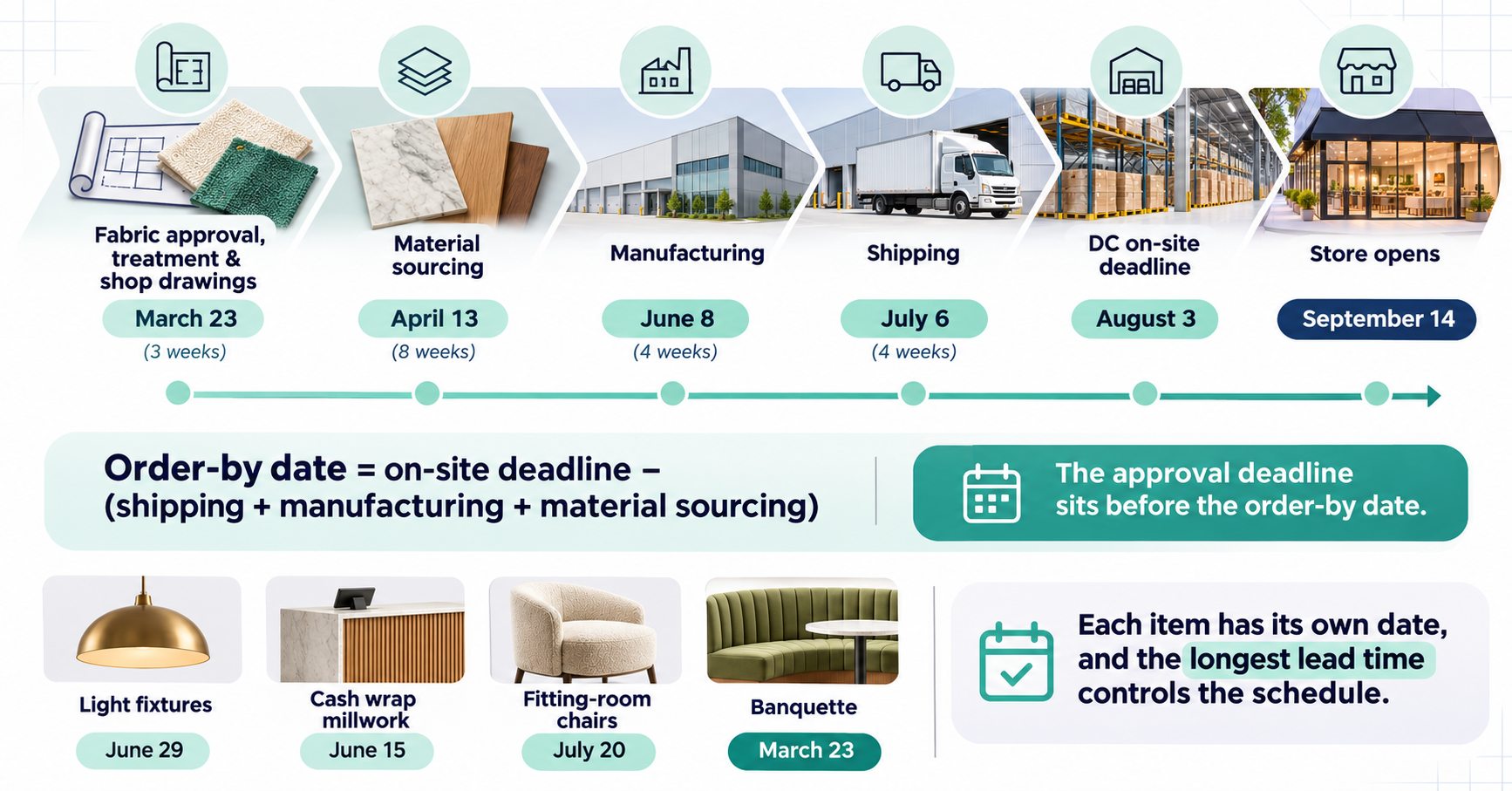
Order-by date = on-site deadline − (shipping + manufacturing + material sourcing), and the approval deadline sits before that.
Here's a worked example. Say a store opens on September 14, and goods must reach the distribution center six weeks ahead so they can be staged and trucked with the rest of the fit-out (one multi-location retailer works to exactly that rule). The on-site deadline for the DC is August 3.
- Shipping: 4 weeks back to July 6.
- Manufacturing: 4 weeks back to June 8.
- Material sourcing: 8 weeks back to April 13.
- Fabric approval, treatment and shop drawings: allow 3 weeks, so approvals close by March 23.
That banquette has to be fully approved almost six months before opening day. If the design team is still choosing between two fabrics in May, the store is already late, and no amount of expediting at the factory will fix it.
Now run the same math on the light fixtures, the cash wrap millwork and the fitting-room chairs. They won't land on the same date. That's the point.
Why does the longest-lead item set the order date for the whole store?
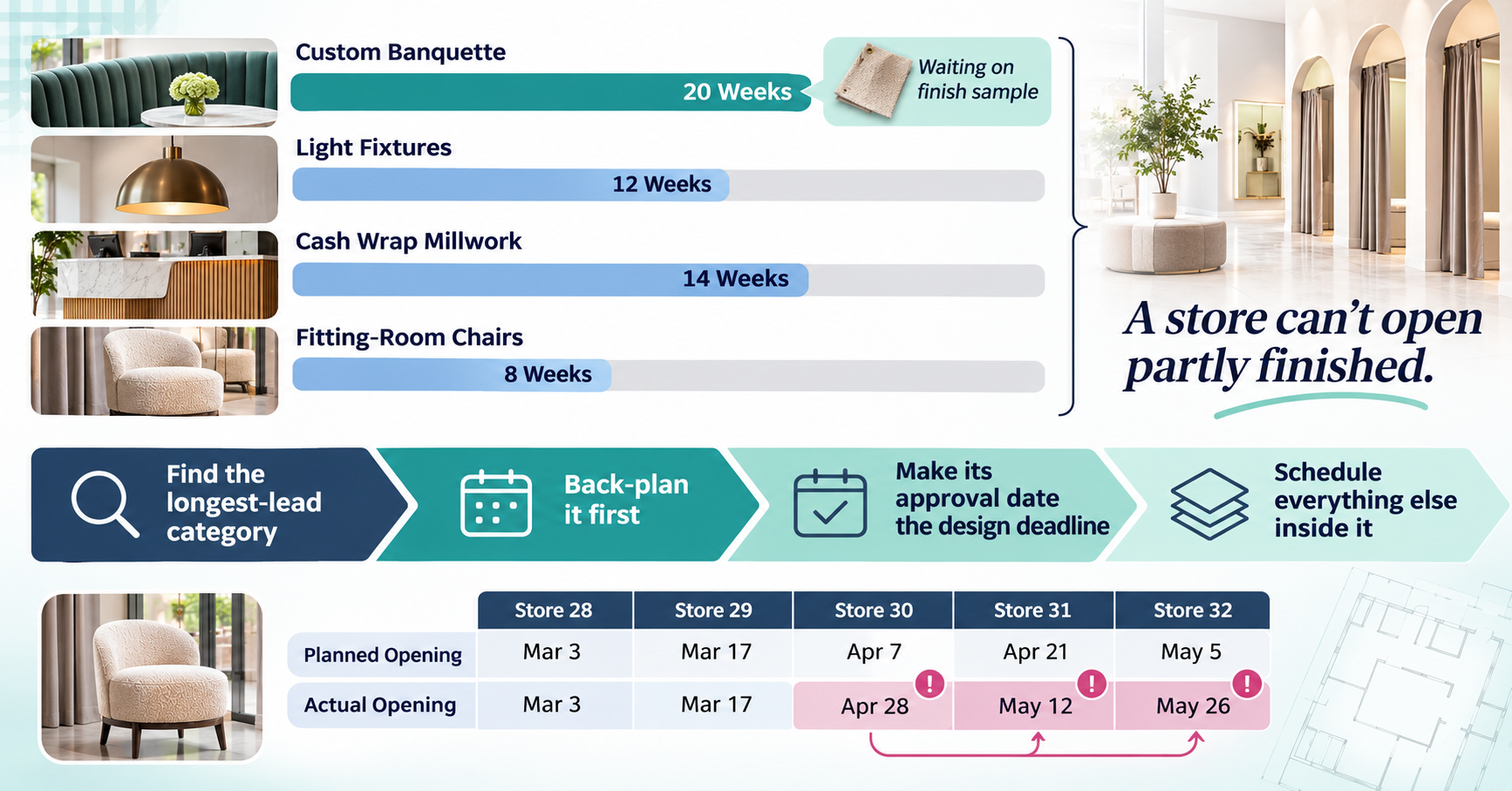
A store can't open partly finished. One missing fitting-room chair is enough to push an opening, because nobody signs off on a store with an empty fitting room. That means the store's real deadline is set by whichever category takes longest, not by the average.
This is where the spreadsheet starts lying. A single "order date" column per project, or a lead time typed once at quote stage, flattens the categories together. The PM sees "ordered" next to most lines and reads the project as on track. Meanwhile the one custom piece with a 20-week chain hasn't been released, because it's waiting on a finish sample that went to the wrong office.
The decision rule: find the longest-lead category for each store typology, back-plan that one first, and make its approval date the design team's real deadline. Everything else gets scheduled inside it.
Rollouts make this sharper. When every store in a program uses the same chair, a late approval doesn't delay one opening. It delays every opening on the calendar that shares the chair.
Who owns each date between design and delivery?
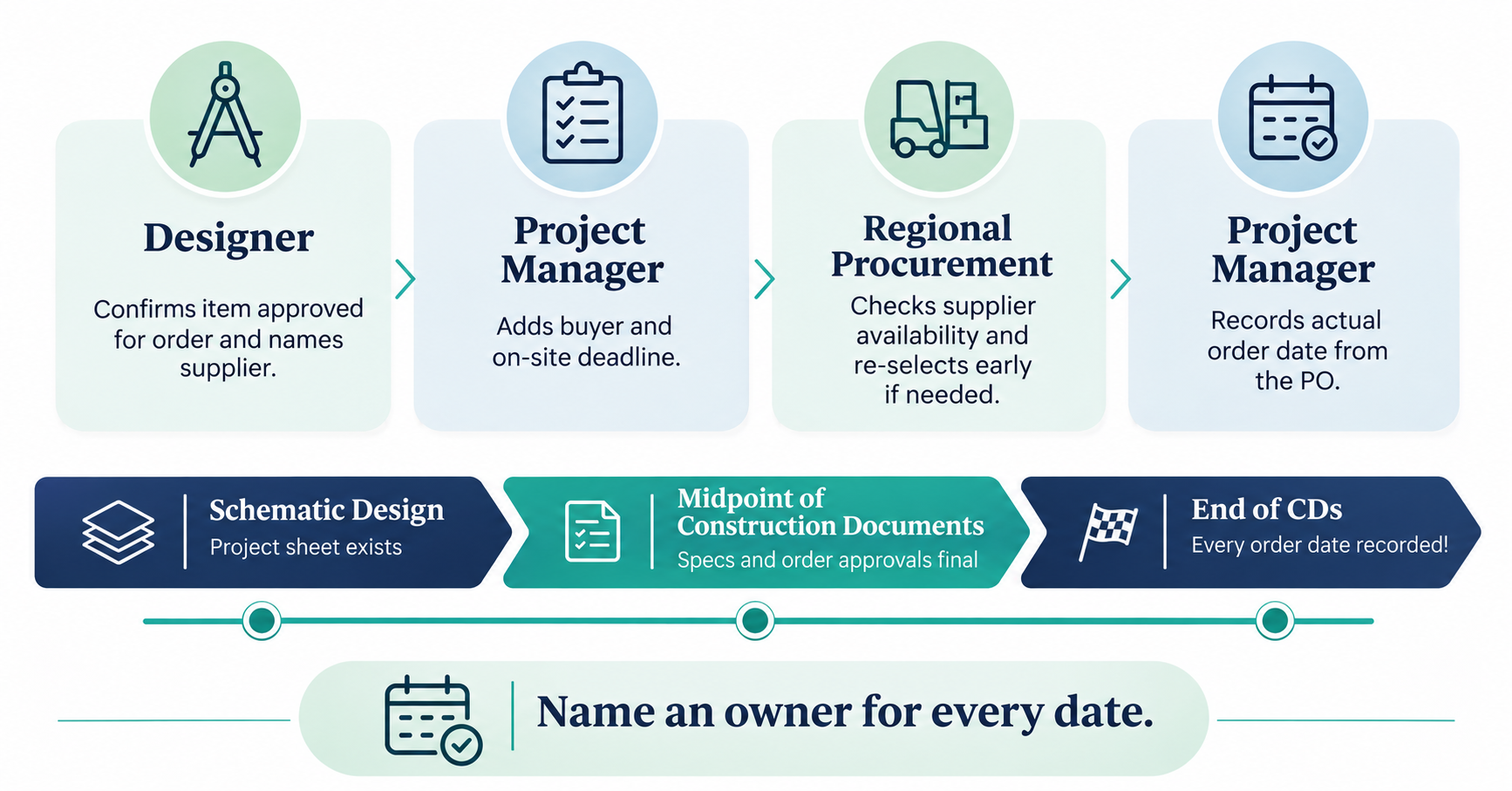
Lead times slip in the handoffs. One global retailer's store guide splits the dates like this, and it's worth copying:
- The designer confirms the item is approved for order and names the supplier.
- The project manager adds the buyer and the on-site deadline for that store.
- Regional procurement checks the supplier's availability against that deadline. If it can't be met, the designer and PM re-select now, not at install.
- The PM records the actual order date from the PO, and only items marked ready to order get a PO at all.
The same guide sets gates against the design phases: the project sheet exists by the end of schematic design, specs and order approvals are final by the midpoint of construction documents, and every order date is in by the end of CDs. That puts the hard conversations months before anyone is standing in an unfinished store.
Notice what's missing from most spreadsheets: a named person on the on-site deadline. If you can't say who owns that date for each item, it's probably you.
What makes FF&E lead times slip after the order goes out?
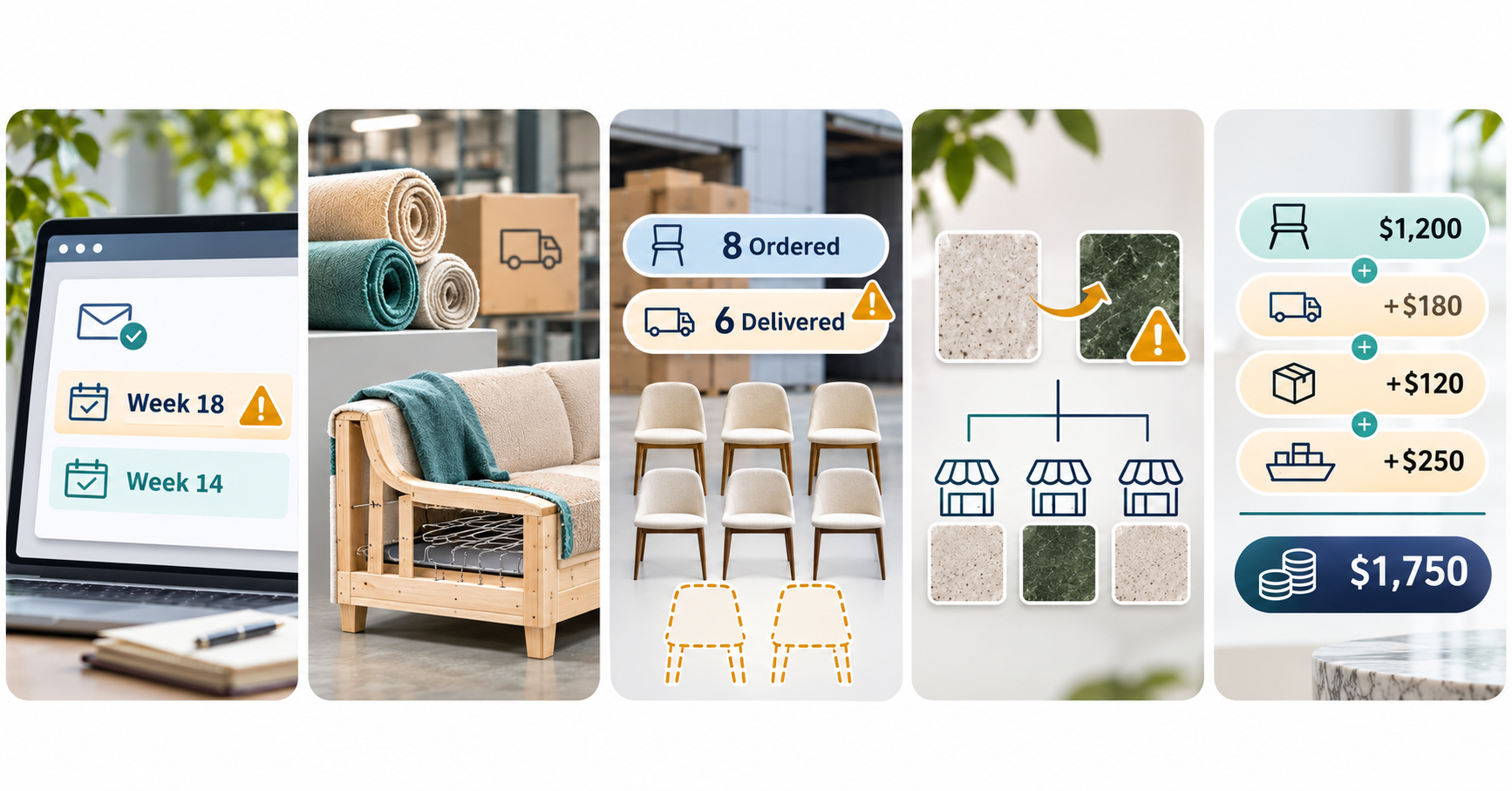
Even a well-planned order drifts. These are the failures that show up again and again.
The acknowledgment nobody checked. The supplier's order acknowledgment confirms the ship date. If it says week 18 and the schedule says week 14, that's the cheapest moment to find out. Many teams file it without comparing.
Components mistaken for finished goods. "The fabric arrived" gets read as "the sofa arrived." The fabric arriving at the upholsterer is the start of a manufacturing clock, not the end of one.
Split shipments. You ordered eight chairs and six arrived. The first shipment gets logged against the order, the remaining two live in an email, and install starts Monday short.
A direction change after the supplier's order cutoff. Design revises a finish after some regions have ordered. Stores in one region get the change, stores in another open with the old version and need a second visit. Each "day two" fix costs crew time, freight and a store that looks unfinished to its first customers.
Costs that move between quote and ship. Freight, duties and import fees commonly add 7 to 12% on top of product cost, and that slice is the part most likely to change in the months between quote and shipment. Tariffs are a live example: since October 14, 2025, imported upholstered wooden furniture has carried a 25% duty, and kitchen cabinets and vanities the same, under a September 2025 proclamation. Scheduled increases to 30% and 50% were postponed to January 1, 2027. A rollout that orders on either side of that date budgets two different stores.
How often should you expedite an FF&E order?
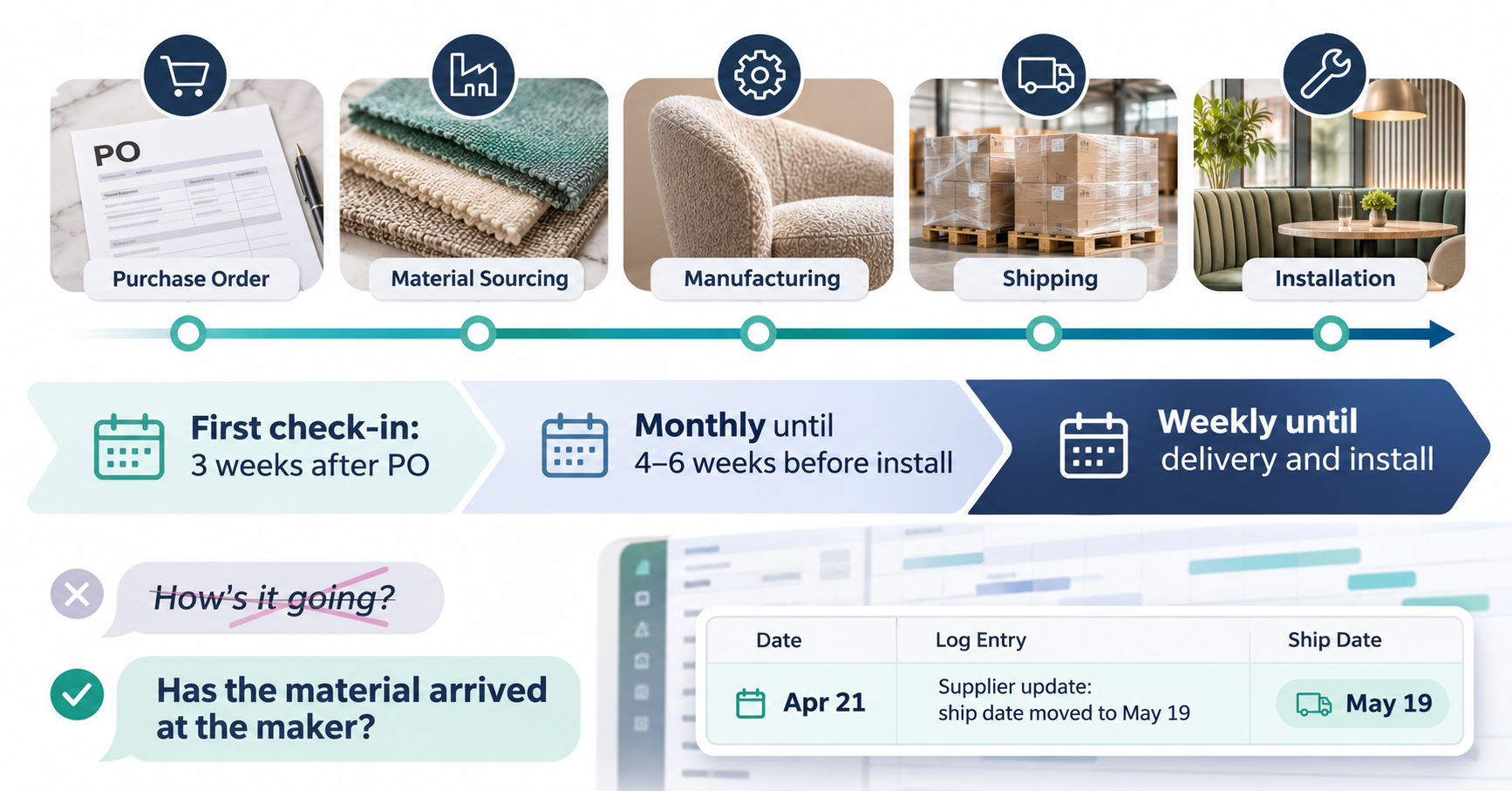
Expediting cadence usually lives in one person's head, which works until that person goes on vacation. Write it down.
One multi-unit restaurant group's draft rule is a good starting point: first check-in three weeks after the PO, monthly until four to six weeks before install, then weekly. Tie each check to a question, not a status. "Has the material arrived at the maker?" is useful. "How's it going?" is not.
And log the answer where the PM can see it, with the date it was given. A ship date that moved in an email thread has not moved for anyone reading the schedule.
What does a late opening actually cost?
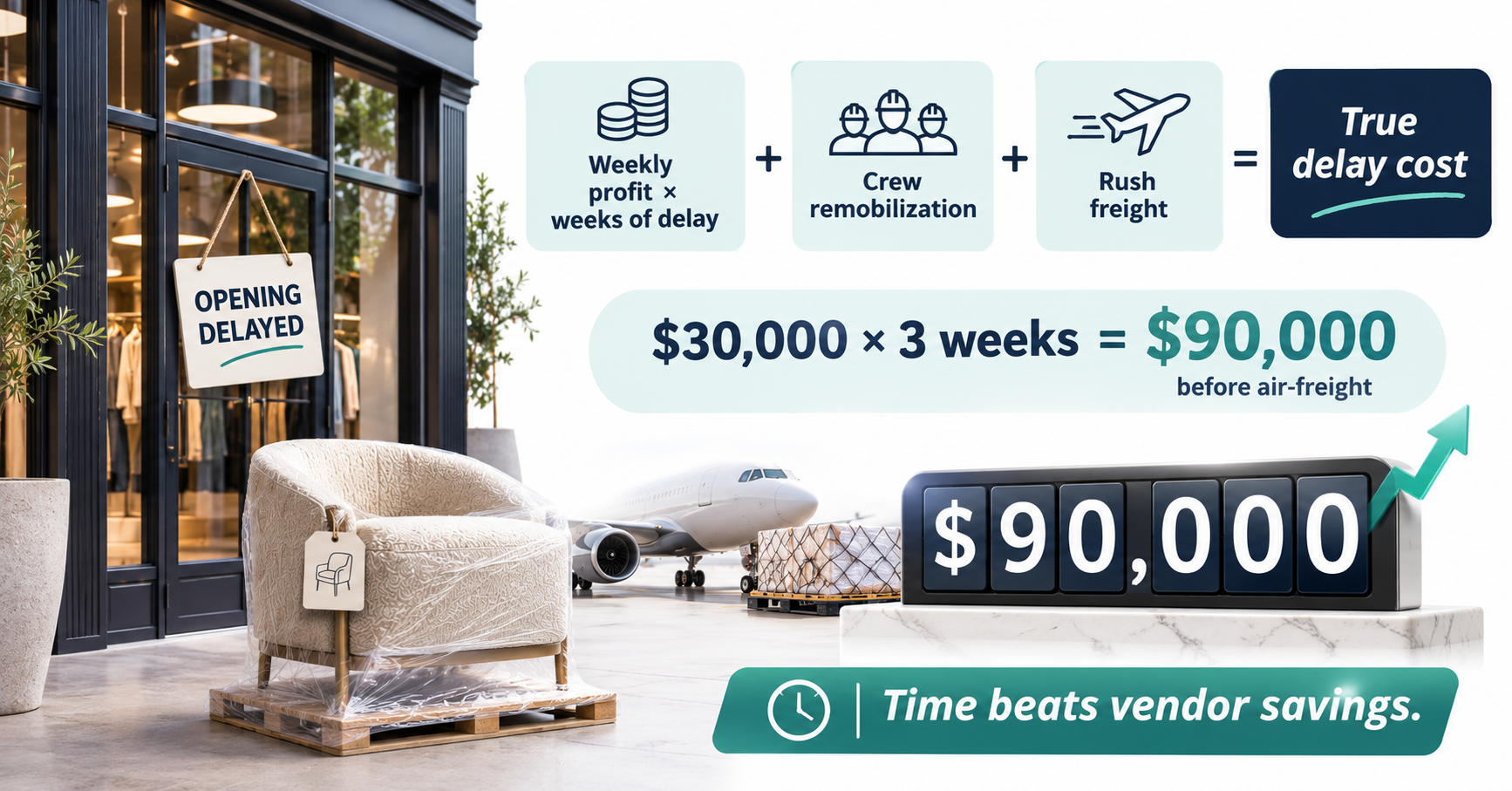
Do this math with your own numbers. Take a store's expected weekly profit, multiply by the weeks of delay, and add the crew remobilization and rush freight it will take to recover. If a store nets $30,000 a week, a three-week slip is $90,000 before you pay to air-freight the missing chair.
That number is why owner teams keep saying the same thing: time beats vendor savings. A 5% discount on a fixture package rarely survives one week of a dark storefront. It's also why the order-by date belongs in front of whoever approves the design, not buried in procurement's tab.
Checklist for the next store you back-plan
- List the on-site deadline for each item, not just the opening date.
- Split each lead time into material, manufacturing and shipping, and note what approval starts the clock.
- Back-plan the longest-lead category first and give design its approval date in writing.
- Name an owner for every date: designer, PM, regional procurement.
- Compare every acknowledgment to the schedule the day it arrives.
- Track partial shipments line by line.
- Set the expediting cadence before the first PO goes out.
Where Fohlio fits
Fohlio keeps the order dates in the same record as the spec. Each item carries schedule milestones (specified, approved, ordered, delivered, installed by), POs and invoices sit against the items they cover, and courier tracking updates ship dates on the order. Items running behind are flagged in the schedule, so the PM sees which line is at risk instead of reading a column of "ordered." See how it works on the FF&E procurement page, or read how teams handle rollout logistics from fabric mill to fitting room, where store rollouts break between design and procurement, and how procurement planning turns an approved spec into a PO.
Brand owners planning their next rollout can also look at SpeCurate by Fohlio for owners and operators, the new platform for standards and specification. Book a Fohlio procurement demo to walk through your own store calendar.
FAQ: FF&E lead times
What is a typical lead time for FF&E?
It depends on the category and whether the piece is stock or custom, so treat any single number with suspicion. Break each quote into material sourcing, manufacturing and shipping, and confirm which approval starts the clock. Custom upholstery and millwork usually carry the longest chains because they wait on fabric, finish and shop-drawing approvals.
How do you calculate an FF&E order-by date?
Start from the on-site deadline for the item, then subtract shipping, manufacturing and material sourcing time. Put the approval deadline before that. Do it per item, because the longest-lead category sets the real deadline for the whole store.
What is expediting in FF&E procurement?
Expediting is the follow-up between purchase order and delivery: confirming acknowledgments, checking materials and production, and catching ship-date changes early. A written cadence, such as monthly until four to six weeks before install and weekly after, keeps it from depending on one person's memory.
Do tariffs affect furniture lead times?
Tariffs mainly affect landed cost, but they also change ordering decisions, which shifts timing. In the U.S., upholstered wooden furniture, kitchen cabinets and vanities have carried a 25% duty since October 2025, with increases scheduled for January 1, 2027. Teams often pull orders forward or re-source ahead of a rate change, which can stretch lead times at popular suppliers.
Fohlio is FF&E specification and procurement software for design firms, purchasing teams and brand owners. Its new platform is SpeCurate by Fohlio.