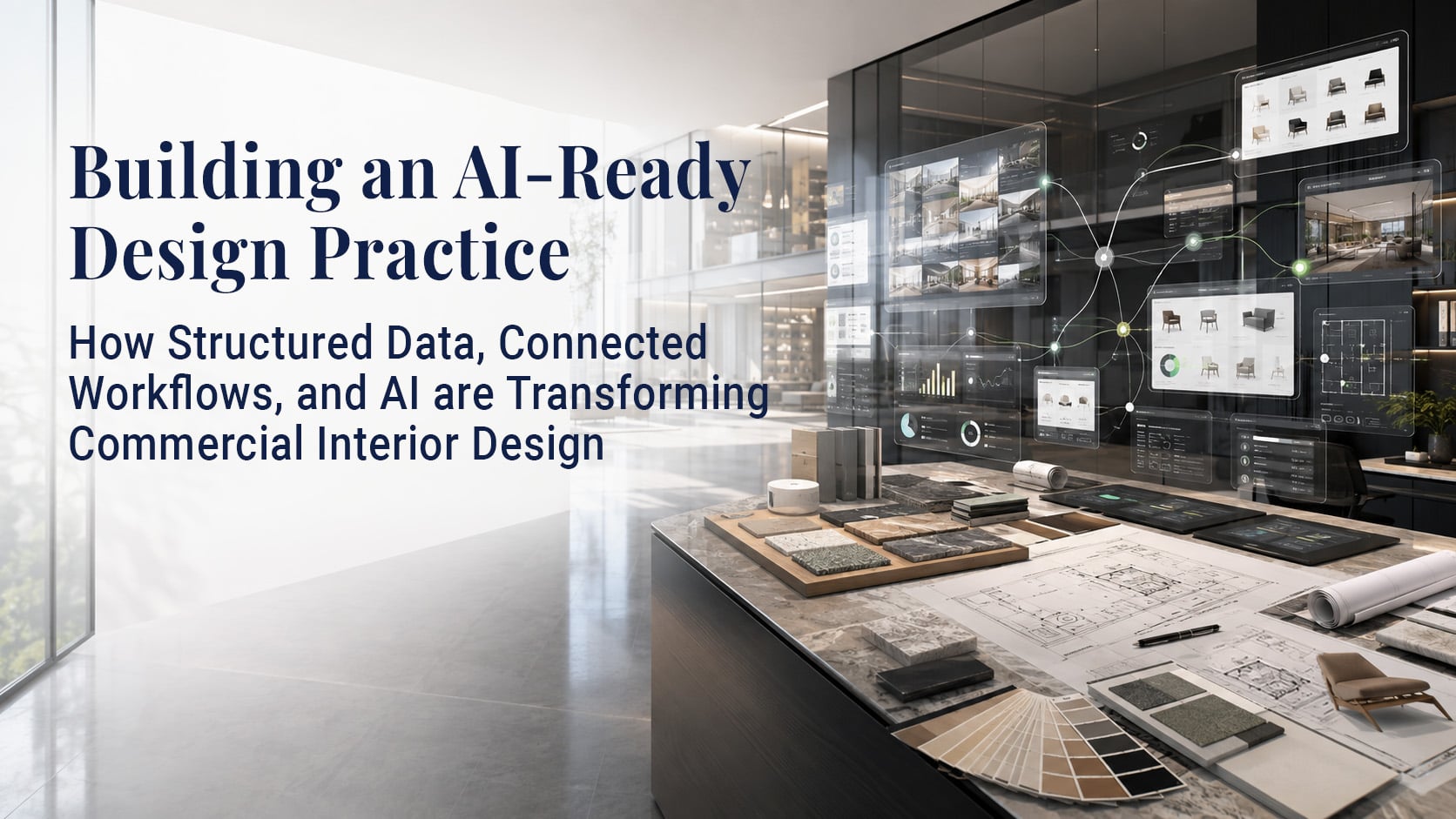
Artificial intelligence is changing how commercial interior design and architecture firms generate ideas, research products, prepare specifications, analyze costs, and manage project information.
Yet adopting AI software does not automatically make a design practice AI-ready.
A firm may use generative AI to create a concept image in minutes and still spend days transferring product information between spreadsheets, specification books, vendor websites, budgets, emails, and purchasing systems. It may automate a single document while continuing to manage the broader project through disconnected files and manual handoffs.
That distinction matters.
AI can accelerate individual tasks, but it cannot reliably coordinate a project when the information behind that project is fragmented, inconsistent, or inaccessible.
The firms positioned to benefit most from AI will not necessarily be those that adopt the greatest number of tools. They will be the firms that organize their product, project, vendor, procurement, and financial information so that both people and technology can understand and reuse it.
An AI-ready design practice begins with a connected data foundation. That foundation makes it possible to:
- Retrieve approved products without searching through old project folders
- Generate specifications from structured product records
- Compare current and historical vendor pricing
- Identify lead-time and availability risks
- Connect product selections to budgets and purchasing
- Preserve institutional knowledge across teams
- Analyze performance across multiple projects
- Automate repetitive administrative work without losing control
Platforms such as Fohlio support this shift by bringing specifications, product information, budgets, procurement workflows, and reporting into a shared environment. Instead of treating each deliverable as a separate document, teams can manage the underlying information as connected, reusable data.
What Is an AI-Ready Design Practice?
An AI-ready design practice is one whose project information is structured, centralized, standardized, and connected well enough for AI to retrieve, analyze, and act on it reliably.
This involves more than digitizing documents.
A firm does not become AI-ready simply because it stores PDFs in the cloud, uses online spreadsheets, or gives employees access to a chatbot. Those tools may improve access, but the information can still remain fragmented and difficult for machines to interpret.
An AI-ready environment preserves the relationships among products, manufacturers, finishes, dimensions, pricing, lead times, specifications, brand standards, project areas, budgets, approvals, vendors, purchase orders, change orders, installation requirements, and profitability.
When those relationships are intact, AI can answer operational questions rather than merely locate documents.
A designer might ask:
Which guest-room lounge chairs have we previously approved that cost less than $900 and have a lead time of fewer than ten weeks?
A procurement manager might ask:
Which vendors have consistently delivered hospitality seating on time?
A finance leader might ask:
Which active projects are at risk of exceeding their FF&E budgets?
Answering these questions requires more than keyword search. The system must understand how specifications, supplier records, prices, project requirements, purchasing activity, and financial information relate to one another.
That is why AI readiness is primarily an information-management challenge.
Platforms such as Fohlio’s design and procurement solution support this shift by bringing specifications, product information, budgets, procurement, workflows, and reporting into a shared environment. Instead of treating each deliverable as a separate document, teams can manage the underlying information as connected, reusable data.
AI Is Not the Revolution—Connected Data Is
Many firms begin their AI journey by asking, “Which AI tool should we use?”
A better starting question is, “Is our firm’s information organized well enough for AI to understand it?”
AI is not a substitute for a data foundation. It is a layer that becomes more useful once the information underneath it is structured, current, and accessible.
Consider a firm with ten years of project experience. Across those projects, it may have accumulated thousands of product specifications, approved brand standards, preferred manufacturer relationships, historical prices, vendor performance records, custom fabrication details, substitutions, installation lessons, and budget outcomes.
That information should be an enormous competitive asset. But when it is distributed across spreadsheets, PDF spec books, inboxes, shared drives, and former employees’ folders, it cannot be reliably searched or reused. The firm possesses the knowledge without being able to consistently access it.
AI does not fix that fragmentation automatically.
If several files contain conflicting prices, AI may not know which one is current. If a product is identified by different names across projects, it may not recognize that the records refer to the same item. If approvals are stored in email while specifications are stored elsewhere, AI may retrieve a product without understanding whether it was actually approved.
This is the unstructured data trap: the information exists, but its format and location make it difficult to use intelligently.
A centralized product and materials library helps firms escape that trap by turning product information into standardized records. In Fohlio, teams can organize specifications, preferred products, approved vendors, custom items, and related project information in a shared library rather than rebuilding that knowledge for each project.
The result is not merely better file organization. It is a foundation from which people, workflows, reports, integrations, and AI can work.
Why Image-First AI Solves Only Part of the Problem
Many designers first experienced generative AI through image creation and visualization.
These tools can produce concept studies, material explorations, furniture arrangements, and photorealistic renderings much faster than traditional workflows. They help teams test ideas, communicate design intent, and gather client feedback earlier.
That is meaningful progress—but producing a convincing image is only one part of delivering a successful commercial interior.
The image must eventually become a coordinated set of decisions involving real products, approved materials, technical specifications, quantities, vendors, prices, lead times, budgets, purchase orders, shipping, and installation.
A rendering may show a visually appropriate chair, pendant, table, or wall finish. But the image alone cannot confirm whether the depicted product:
- Is commercially available
- Meets project performance requirements
- Is approved by the client or brand
- Fits the allocated budget
- Can be delivered on schedule and in the required quantity
- Complies with regional standards
- Coordinates with the intended installation method
- Has an acceptable alternate
The concept may be visually compelling while remaining commercially unrealistic.
To close the gap between inspiration and execution, design teams need a system that connects design intent to usable product intelligence. Fohlio’s Spec Builder, for example, allows teams to develop specifications using information connected to a centralized product library. Those records can then support reports, estimates, approvals, and procurement workflows without requiring teams to recreate the same information.
This creates a more practical path for AI adoption: AI works within a controlled environment of products, attributes, standards, and project requirements instead of generating ideas in isolation.
Why AI Fails Without Connected Project Context
Imagine asking AI:
Show me every hospitality lounge chair our firm specified during the past five years that costs less than $900, has a lead time under ten weeks, and complies with Brand X.
At first, this sounds like a straightforward search. In reality, the system must determine:
- What qualifies as a lounge chair
- Which projects were hospitality projects
- Which products were considered versus finally specified
- Which specifications received approval
- Whether a recorded price was an estimate, quote, or purchase price
- When the price and lead time were last updated
- Whether the lead time applies to the specified finish
- What rules define Brand X compliance
- Whether the product remains available
- Whether an approved vendor is attached to the record
A conventional file search may locate documents containing some of those terms, but it cannot necessarily evaluate the relationships among them.
Reliable AI requires connected context. That context is created when product data is linked to specifications, project areas, approvals, vendors, budgets, and purchasing activity.
Fohlio’s spec-to-procure workflow is built around this principle. Product records can remain connected to approved specifications, pricing, vendors, alternates, budgets, and order information rather than being repeatedly transferred into unrelated documents.
The value is not simply that the information is stored in one application. The value is that the relationships among decisions remain intact.
Where Fragmented Workflows Create Time, Cost, and Risk
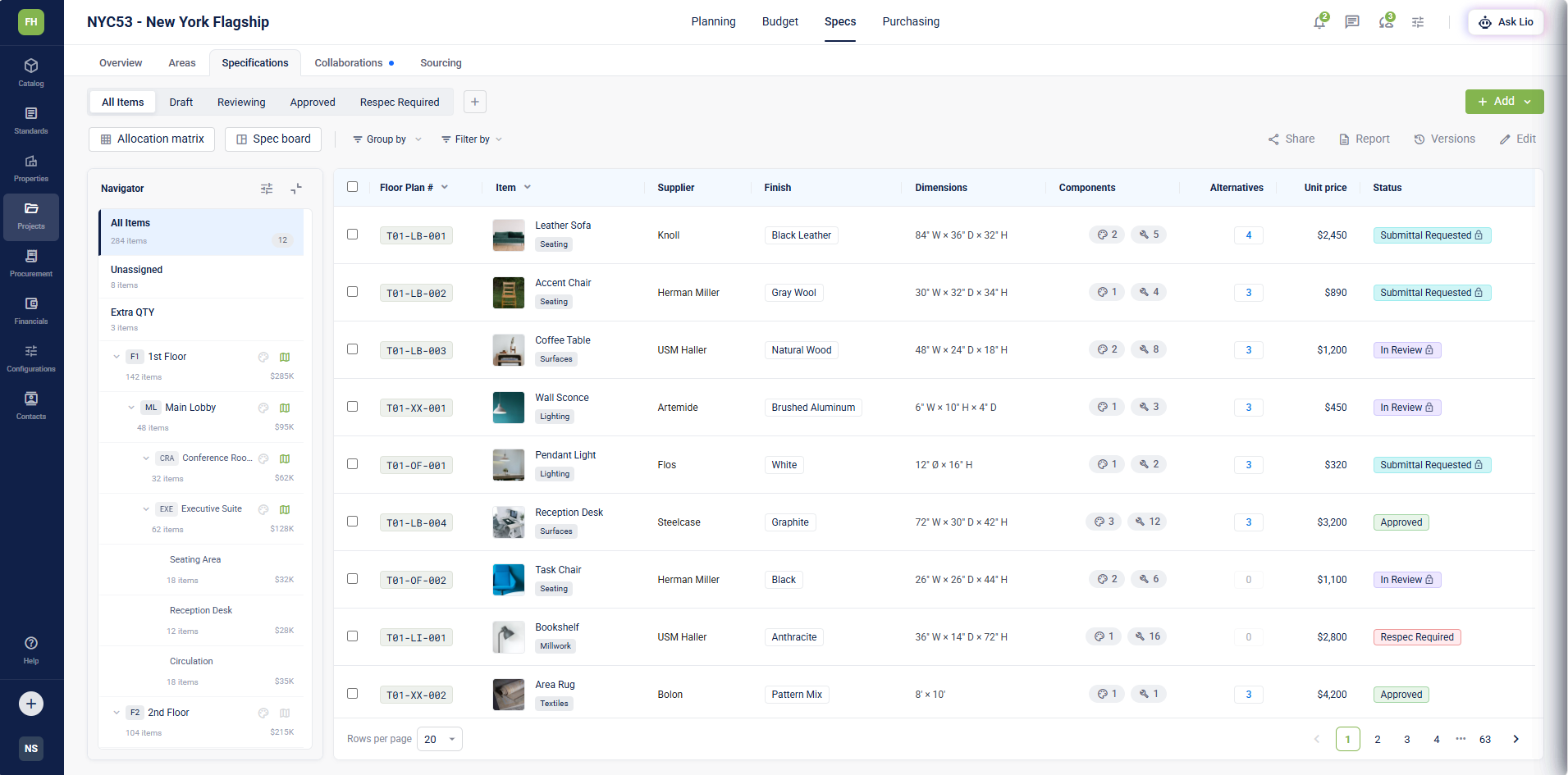
A typical commercial interior project may use spreadsheets for product schedules, PDFs for specifications, shared drives for documentation, email for approvals, vendor websites for research, accounting software for costs, separate procurement systems, presentation software for client reviews, and BIM or CAD tools for drawings.
Each tool may perform its individual function well. The problem appears when information moves between them.
A designer selects a product from a manufacturer’s website and enters it into a spreadsheet. The same information is reformatted for a specification sheet. Procurement transfers it into an RFQ. A quote arrives as a PDF and must be compared with the original specification. Approved pricing is entered into a budget. The purchasing team then recreates the information in a purchase order or accounting platform.
At every stage, someone must find the correct information, confirm that it is current, reformat or re-enter it, check it for errors, and notify the next stakeholder.
This repeated work creates operational drag across tasks such as:
- Product and material research
- Writing and revising specifications
- Searching previous projects for approved products
- Requesting and comparing vendor quotes
- Updating budgets after design changes
- Creating RFQs and purchase orders
- Tracking approvals, revisions, lead times, and deliveries
- Reconciling invoices against orders
- Preparing client and leadership reports
It also creates risk. A finish may change in the specification but not in the budget. A client-approved product may not appear in the purchase order. A vendor may quote an outdated quantity. Procurement may order from an obsolete specification. Finance may analyze committed costs using incomplete purchasing data.
Individually, these can look like minor administrative mistakes. Collectively, they lead to incorrect orders, expedited freight, budget overruns, rework, schedule delays, change orders, lost margins, and compromised design intent.
The risk increases as firms manage more projects, offices, locations, or brands. As more people interact with the information, it becomes harder to determine which version is current and which decisions are approved.
Connected workflows reduce that ambiguity. Fohlio’s custom workflows and role-based controls allow stakeholders to work from shared project information while seeing the fields, pricing, and approval actions relevant to their responsibilities.
This governance is essential for AI readiness. An AI assistant cannot make dependable recommendations if the system does not distinguish between draft and approved information, current and obsolete pricing, or selected and purchased products.
Stop Thinking in Documents—Start Thinking in Data
Documents are useful outputs. Specification books, schedules, budget reports, purchase orders, and finish presentations will continue to play an important role in project delivery.
The problem occurs when the document becomes the primary place where information lives.
A PDF is a snapshot. A spreadsheet often becomes a separate version of reality. A presentation may contain product information that is not connected to the specification. A purchase order may repeat details that already exist elsewhere.
Once information is trapped in separate documents, every change creates additional work.
Consider a simple finish revision. If the finish is represented independently in a specification sheet, client presentation, budget, procurement tracker, and purchase order draft, the team may need to update five files. If one is overlooked, stakeholders begin working from conflicting information.
Data thinking reverses this model.
The product, finish, price, vendor, and approval status are managed as connected records. Documents and reports are then generated from those records for different audiences.
A designer may generate a visual specification report. Procurement may generate an RFQ or purchase order. Finance may review estimated and committed costs. A client may see an approval-focused presentation. The views differ, but the underlying information remains consistent.
Fohlio’s Spec Builder and configurable reporting tools support this approach by allowing teams to create stakeholder-specific outputs from shared product and project information.
Unlike a static document, structured data can evolve. Teams can update a record when pricing changes, a finish becomes unavailable, a quantity is revised, or an alternate is approved. They can also preserve the history of earlier prices, product selections, approvals, substitutions, lead-time updates, purchasing activity, and installation outcomes.
That history matters to AI. Recommendations are more reliable when the system can distinguish between current and historical pricing, proposed and approved products, and initial and final specifications.
Structured Specifications Create a Common Language
Specifications are often treated as final project documents. For an AI-ready practice, they should be treated as structured knowledge.
A strong specification captures more than a product name and image. It creates a consistent record of the attributes required to evaluate, approve, purchase, install, and maintain the product.
Depending on the category, those attributes may include:
- Manufacturer, product name, and model number
- Category, dimensions, material, finish, and color
- Performance requirements, fire ratings, and sustainability certifications
- Warranty, installation, and maintenance requirements
- Unit price, freight assumptions, lead time, and minimum order quantity
- Vendor and vendor contact information
- Approval and substitution status
- Related documents
Different categories require different attributes. A chair may need upholstery, frame finish, seat height, weight capacity, and testing information. A lighting fixture may require lamping, voltage, mounting, controls, and certification details. A surface material may require thickness, pattern, edge treatment, substrate, and installation requirements.
Standardizing these attributes by category makes information more complete and comparable. It also allows AI to interpret products more accurately.
Consistent naming is equally important. One vendor may use “brushed brass,” another “satin brass,” and a third “warm metallic gold.” A firm may use “lounge chair,” “club chair,” “guest chair,” and “accent chair” for similar functions.
Humans can interpret many of these variations from context, and AI may recognize some similarities. But inconsistent naming still creates ambiguity when firms need exact compliance, reporting, budgeting, or procurement results.
A structured system allows organizations to define preferred categories, required fields, naming conventions, controlled values, room names, project phases, approval statuses, units of measurement, and vendor names.
Fohlio’s customizable specification environment allows firms to organize FF&E, OS&E, finishes, architectural materials, custom products, and other categories according to their own requirements rather than forcing every item into a generic format.
Product Libraries Turn Project History Into Firm Knowledge
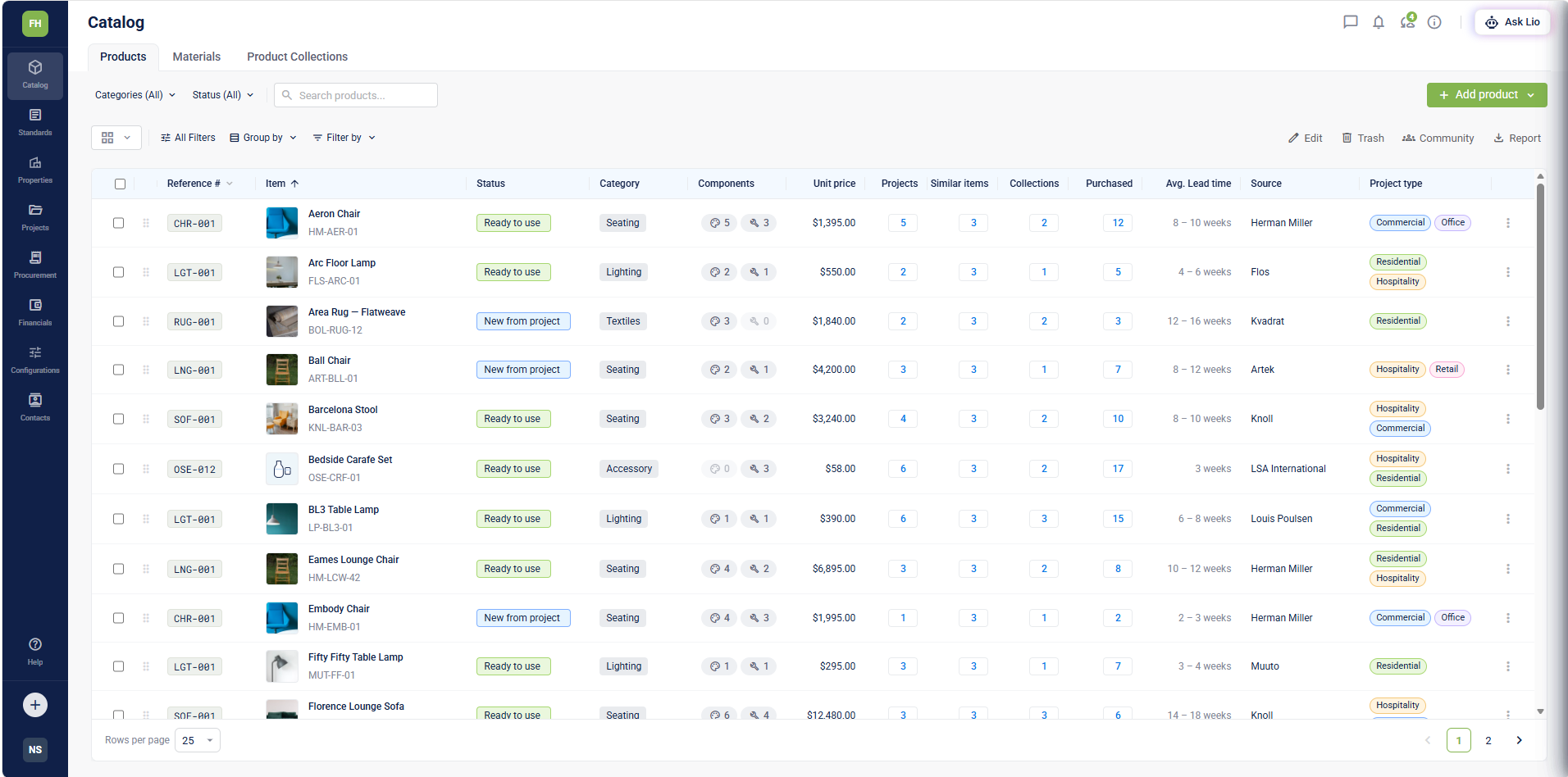
A product record becomes more valuable each time the organization adds context to it.
It may begin with a manufacturer, dimensions, finish options, and a price. Over time, the firm can add approved applications, brand compliance, historical quotes, installed costs, alternate vendors, lead-time performance, regional availability, client feedback, installation lessons, maintenance considerations, and images from completed projects.
The product is no longer merely an item from a catalog. It becomes firm knowledge.
That distinction is important because much of a design firm’s competitive advantage comes from knowing which products work, where they work, what they truly cost, and how reliably they can be delivered.
When this knowledge exists only in individual employees’ memories, it is difficult to share, preserve, and scale. Experienced team members become informal search engines. New employees may have access to final documents without understanding why an item was selected, rejected, substituted, or removed from a standard.
A centralized library makes this context reusable. A junior designer can access products senior team members have already evaluated. A new office can work from established brand standards. Procurement can identify previously used vendors. Project managers can review installation requirements before work reaches the site.
The firm also retains that knowledge when employees change roles or leave.
A useful product library should reflect the organization’s decision-making process rather than becoming one undifferentiated database. Products might be organized by category, project type, asset class, client, brand, region, room, price level, approval status, preferred vendor, availability, or lead time.
Fohlio allows firms to configure libraries and custom properties around these requirements, helping the library function as an operational tool rather than a passive archive.
For a deeper look at this approach, teams can reference The Backbone of Better Design: Fohlio’s Product and Materials Library.
Reusable Standards Reduce Reinvention
Without shared product intelligence, design teams often repeat work the firm has already completed. They search for similar products, request the same technical information, recreate specifications, rebuild budgets, and rediscover installation limitations.
Every project has unique needs, but starting from zero is rarely necessary.
A structured library allows teams to begin with relevant precedent. A hospitality team can review products approved for similar properties. A retail team can reuse items associated with a brand standard. A workplace team can identify seating that previously met budget, durability, and sustainability requirements.
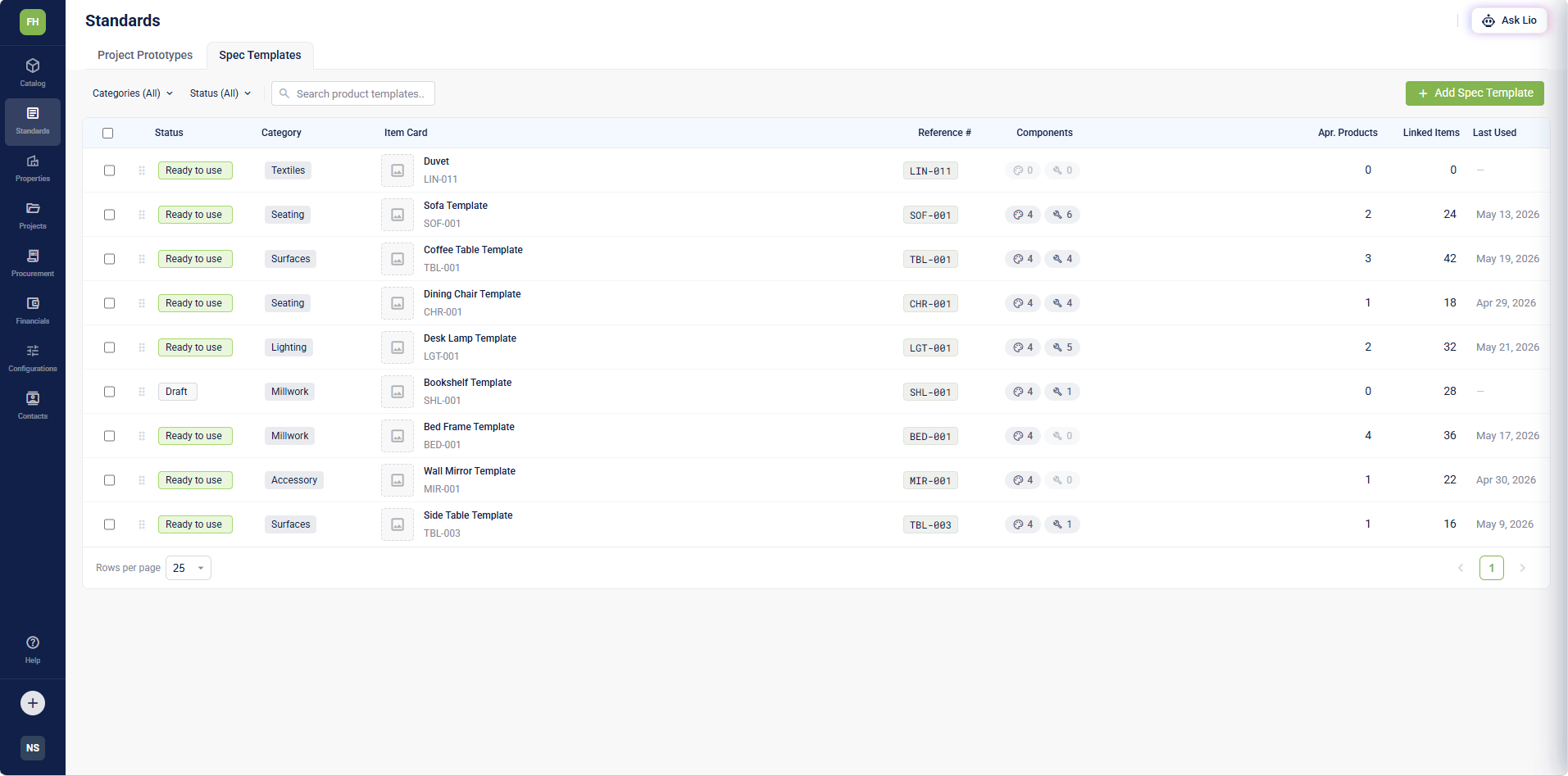
Firms can go further by creating reusable product assemblies rather than managing only isolated items.
A guest room may include a bed, nightstands, lighting, window treatments, flooring, wall finishes, hardware, and accessories. A retail display zone may include custom millwork, lighting, power, signage, fixtures, and installation components.
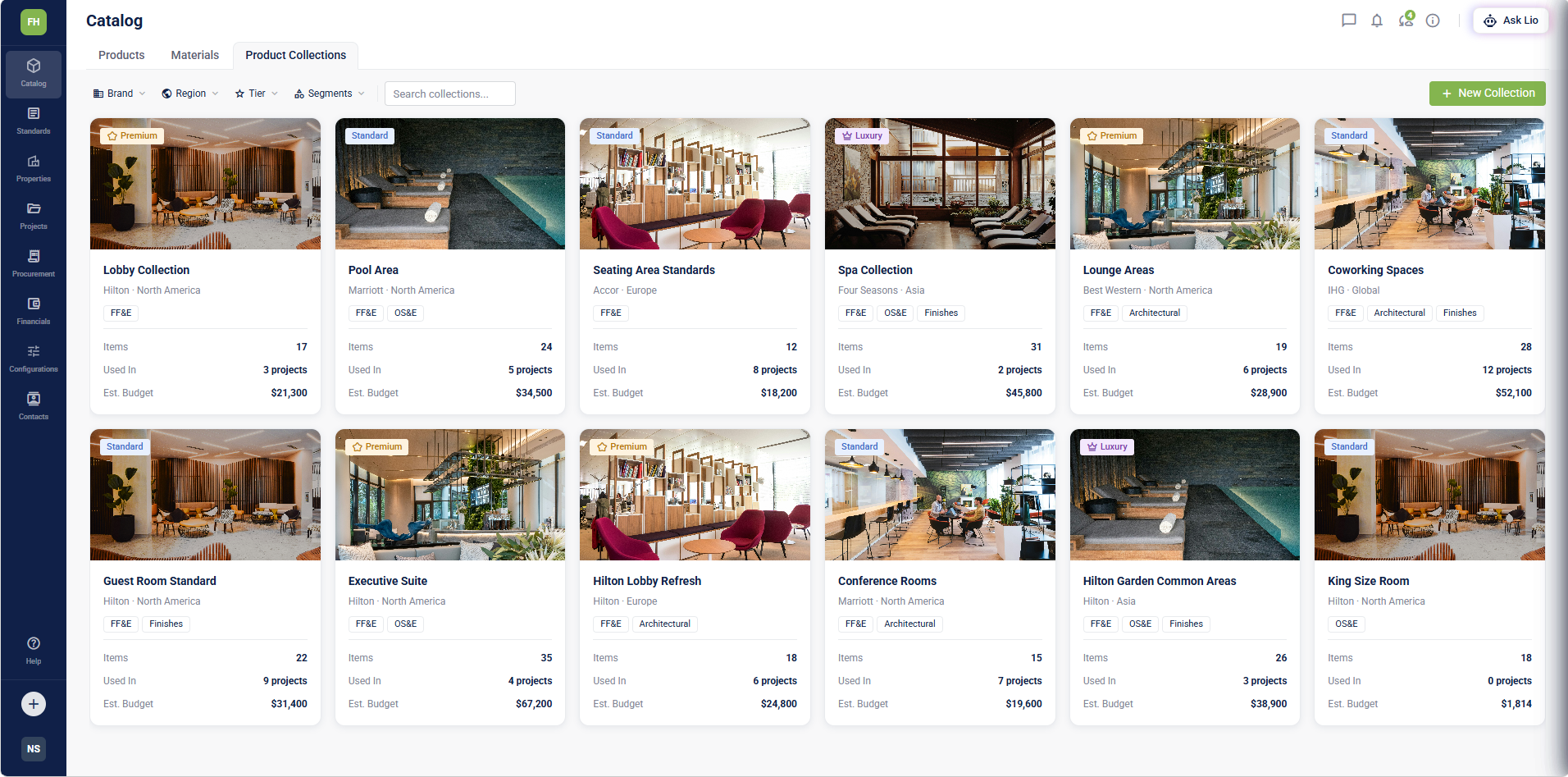
An assembly—or Product Collection—can preserve the products, quantities, relationships, and supporting details associated with a recurring space or design condition. This helps firms estimate recurring spaces, apply brand standards, reuse proven combinations, compare prototype variations, forecast fully loaded costs, and accelerate multi-location rollouts.
Instead of asking only, “What does this fixture cost?” the firm can evaluate the complete installed requirement surrounding it.
Teams beginning this process can also use The Ultimate Guide to Setting Up Your Online Materials Library as a practical reference.
What Connected Data Allows AI to Do
Once a firm’s information is structured and connected, AI can support practical project work rather than isolated content generation.
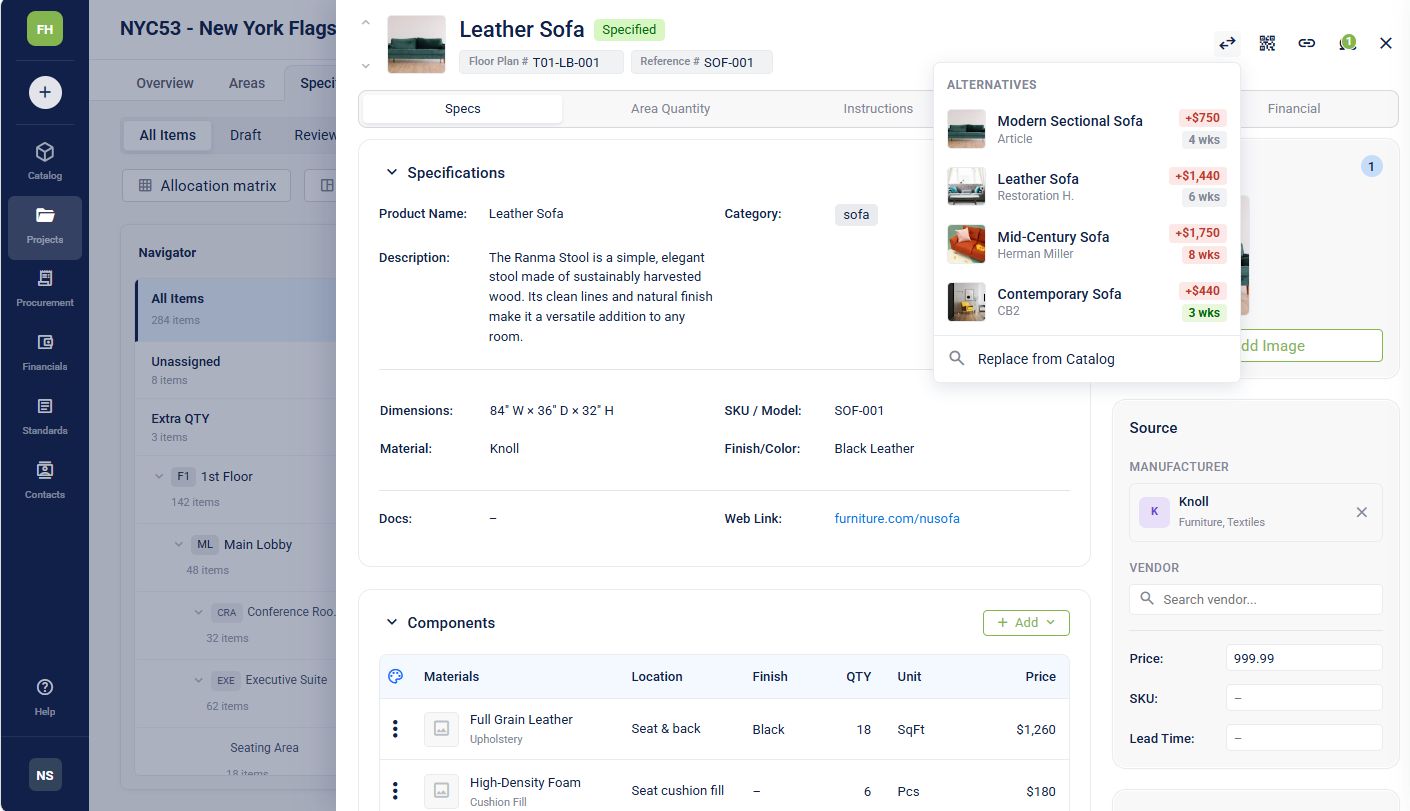
Recommend relevant products
AI can begin with the firm’s approved or previously used products and filter them by project type, price, lead time, finish, performance, geographic availability, brand standard, or preferred vendor.
Instead of asking, “Find me a chair,” a designer can ask:
Show me lounge chairs approved for luxury hospitality projects that cost under $900, ship within ten weeks, and coordinate with this finish palette.
Because the recommendations come from organizational knowledge rather than the open internet alone, they are more likely to be practical and commercially viable.
Generate and review draft specifications
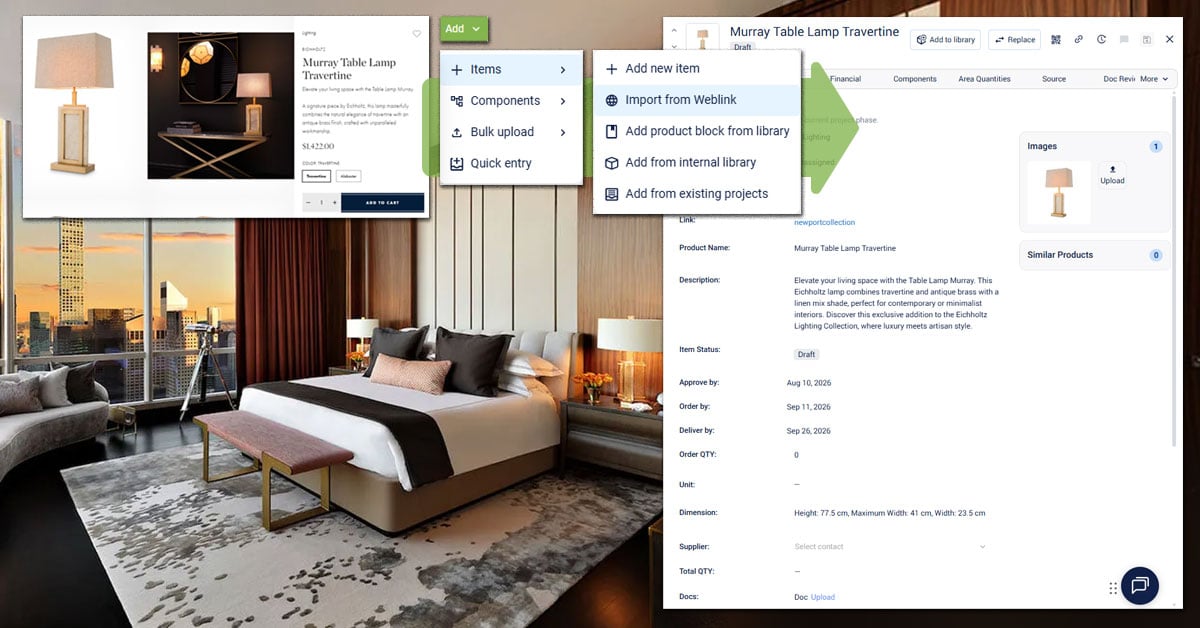
AI can extract and organize product information from manufacturer websites, data sheets, PDFs, spreadsheets, and existing records. Designers can then review and approve a draft rather than recreating the specification from the beginning.
The system can also flag missing attributes—such as dimensions, warranties, lead times, or installation requirements—before an item moves further into the workflow.
Fohlio’s AI-assisted product import and Spec Builder help teams bring product information into a structured environment where it can support specifications and downstream workflows.
Retrieve historical project knowledge
Instead of opening archived folders or contacting former project team members, users can ask questions about previously specified products, suppliers, costs, approvals, substitutions, and performance.
The system searches relationships, not just filenames.
Compare vendor quotes
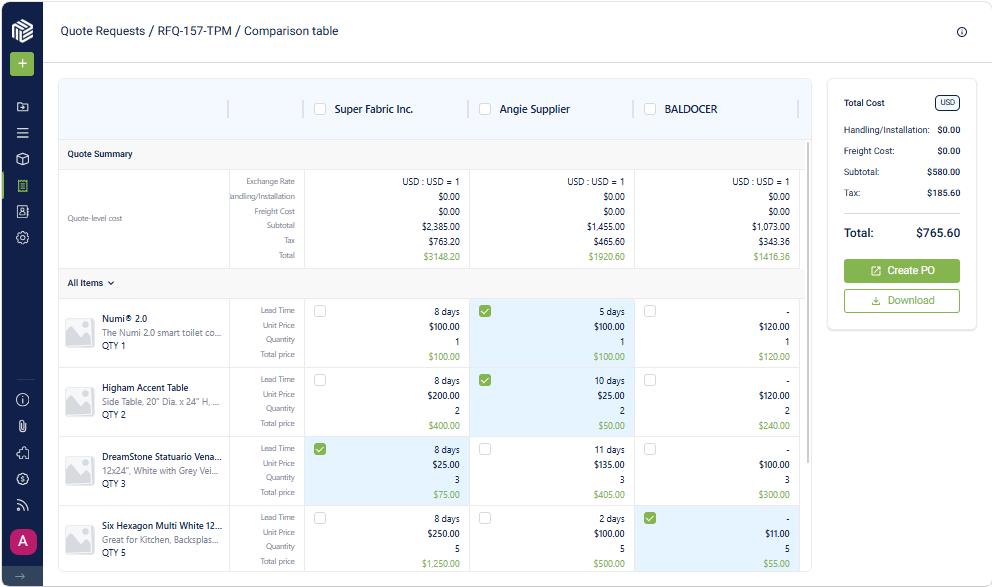
Supplier quotes often arrive in different formats and use inconsistent terminology. AI can extract unit prices, freight, lead times, quantities, taxes, alternates, installation assumptions, and payment terms into a comparable structure.
It can then highlight pricing differences, missing information, unusual lead times, and potential budget impacts so procurement professionals can focus on exceptions and purchasing decisions.
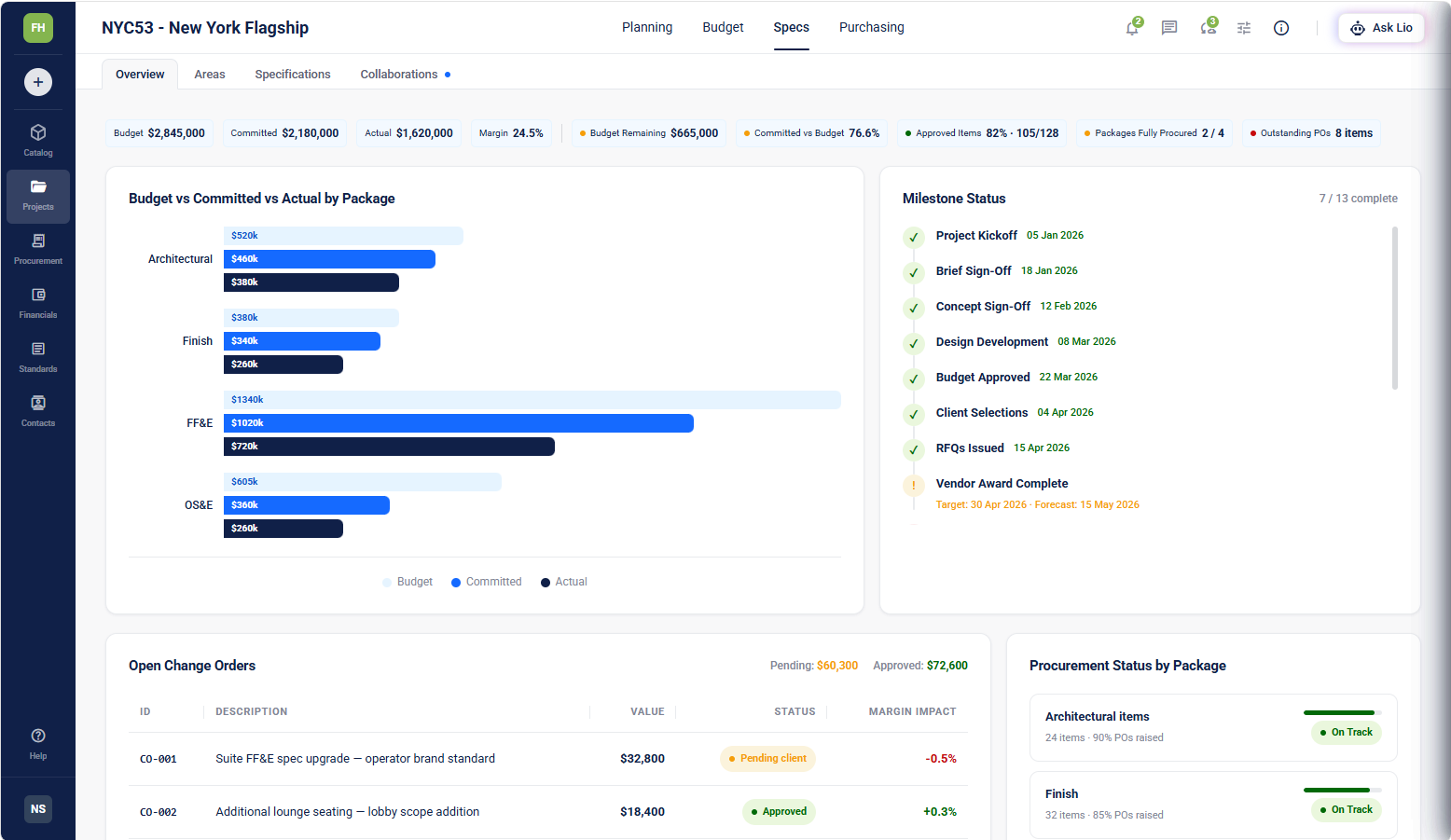
Create living budgets
When specifications, quantities, quotes, approvals, and purchase activity remain connected, budgets become dynamic rather than static.
AI can help surface overruns, cost-saving alternatives, freight increases, vendor price changes, margin impacts, and procurement risks while teams can still act on them—not after project completion.
Generate project deliverables
Finish schedules, product schedules, procurement reports, RFQs, purchase orders, approval reports, budget summaries, and vendor packages all reuse information that already exists elsewhere.
When connected data serves as the source of truth, teams can generate these deliverables from the underlying records rather than manually rebuilding them. Consistency improves because every output references the same project information.
AI-Assisted Data Ingestion Accelerates the Foundation
Creating a structured data environment requires effort. Firms may have years of information stored in spreadsheets, PDFs, floor plans, quotes, websites, and legacy specifications. Manually rebuilding every record would be difficult.
AI-assisted ingestion can accelerate the transition.
Product information can be extracted from manufacturer websites, uploaded documents, spreadsheets, and other sources, then organized into proposed fields for review. Teams validate the information before it becomes part of the firm’s trusted library.
This human-in-the-loop approach is important. AI reduces data-entry work, people preserve quality and judgment, and the platform maintains the connected record.
The objective is not uncontrolled automation. It is faster creation of reliable, reusable information.
One Source of Truth, Multiple Stakeholder Views
A single source of truth does not mean every stakeholder sees the same screen or has access to every detail.
Different roles need different views:
- Designers: Images, finishes, dimensions, specifications, design intent, and approvals
- Procurement: Vendors, quotes, lead times, order status, freight, and delivery
- Finance: Estimated costs, committed costs, margins, invoices, and cash flow
- Clients: Selected products, visual presentations, approval actions, and approved budget information
- Leadership: Portfolio performance, project risk, vendor trends, profitability, and schedule status
The underlying data can remain shared while permissions, reports, and interfaces are tailored to each role.
Fohlio’s custom workflows, role-based permissions, and reporting capabilities help firms preserve collaboration without exposing irrelevant or sensitive information. These controls also give AI clearer boundaries by defining which data is approved and who can access it.
Firms seeking to reduce the gap between design and purchasing can explore Fohlio’s guidance on streamlining design and procurement workflows.
AI-Assisted Data Ingestion Accelerates the Foundation
Creating a structured data environment requires effort. Firms may have years of information stored in spreadsheets, PDFs, floor plans, quotes, websites, and legacy specifications. Manually rebuilding every record would be difficult.
AI-assisted ingestion can accelerate the transition.
Product information can be extracted from manufacturer websites, uploaded documents, spreadsheets, and other sources, then organized into proposed fields for review. Teams validate the information before it becomes part of the firm’s trusted library.
This human-in-the-loop approach is important. AI reduces data-entry work, people preserve quality and judgment, and the platform maintains the connected record.
The objective is not uncontrolled automation. It is faster creation of reliable, reusable information.
One Source of Truth, Multiple Stakeholder Views
A single source of truth does not mean every stakeholder sees the same screen or has access to every detail.
Different roles need different views:
- Designers: Images, finishes, dimensions, specifications, design intent, and approvals
- Procurement: Vendors, quotes, lead times, order status, freight, and delivery
- Finance: Estimated costs, committed costs, margins, invoices, and cash flow
- Clients: Selected products, visual presentations, approval actions, and approved budget information
- Leadership: Portfolio performance, project risk, vendor trends, profitability, and schedule status
The underlying data can remain shared while permissions, reports, and interfaces are tailored to each role.
Fohlio’s custom workflows, role-based permissions, and reporting capabilities help firms preserve collaboration without exposing irrelevant or sensitive information. These controls also give AI clearer boundaries by defining which data is approved and who can access it.
AI Completes Tasks. Platforms Complete Projects.
One of the most important distinctions design leaders should understand is the difference between AI and a connected project platform.
AI can summarize documents, generate draft specifications, compare vendor quotes, recommend products, draft purchase orders, and extract product information.
These are valuable capabilities. But commercial interior design projects involve hundreds of interconnected activities across design, procurement, client approvals, budgets, vendor communication, change orders, installation, reporting, and executive oversight.
AI alone does not maintain project governance, coordinate approvals, preserve organizational standards, manage permissions, or monitor portfolio performance.
That responsibility belongs to the project platform.
Platforms provide the operating system. AI provides intelligent assistance within it.
Fohlio exemplifies this approach by connecting specification management, product intelligence, budgeting, procurement, workflows, and reporting in one environment where AI can work with trusted information instead of disconnected files.
Case Study: Connected Data Across More Than 60 Retail Projects
A global luxury retail brand managing more than 60 active store projects faced a challenge familiar to enterprise design organizations. Corporate design teams, regional offices, procurement professionals, and suppliers maintained separate spreadsheets, PDFs, and project documentation.
As a result, understanding the true installed cost of products became increasingly difficult.
A decorative lighting fixture priced at $2,000 could ultimately exceed $5,000 after accounting for custom fabrication, regional wiring, shades, packaging, international freight, duties, installation, and local compliance requirements.
Because these components were tracked independently, teams could commit budgets before understanding the complete financial impact.
The organization addressed the challenge by standardizing recurring store environments with reusable Product Blocks. Instead of rebuilding each environment for every location, teams could create complete assemblies containing products, quantities, specifications, procurement information, and cost assumptions.
Cross-project reporting gave leadership visibility across active locations, helping teams identify shared suppliers, procurement bottlenecks, lead-time risks, budget exposure, vendor performance, and purchasing trends.
Live specifications reduced duplicate work while helping design, procurement, and finance collaborate from the same project information.
The outcome was more than improved reporting. It was a different operating model built around connected information rather than disconnected documents.
AI becomes most valuable inside this kind of ecosystem. Without connected data, automation remains limited. With connected data, it can support the project from selection through purchasing and analysis.
How to Begin Building an AI-Ready Design Practice
Firms do not need to transform every system at once. A practical starting plan is to:
- Map where critical information lives. Identify the spreadsheets, PDFs, shared drives, inboxes, and applications that hold product, specification, vendor, budget, approval, and procurement data.
- Find repeated handoffs. Look for places where teams copy, reformat, or recreate information that already exists elsewhere.
- Centralize product knowledge. Build a shared library of approved, preferred, previously specified, and project-specific products.
- Standardize essential fields. Establish required attributes, naming conventions, categories, units, and approval statuses.
- Capture decision context. Preserve why products were approved, rejected, substituted, or removed—not only the final document.
- Connect specifications to downstream work. Link product records to estimates, approvals, quotes, budgets, purchasing, delivery, and reporting.
- Create reusable standards. Develop templates, assemblies, prototypes, and brand libraries for recurring spaces and project types.
- Define governance. Assign ownership, permissions, review steps, and version-control rules so AI works with trusted information.
- Introduce AI where the data is ready. Begin with high-value repetitive tasks such as product ingestion, specification drafting, historical search, quote comparison, and reporting.
- Improve the system with every project. Capture final pricing, vendor performance, substitutions, installation outcomes, and lessons learned.
The objective is not to adopt AI everywhere at once. It is to build an operating environment in which AI can become more reliable, useful, and valuable over time.
Frequently Asked Questions
What is an AI-ready design practice?
An AI-ready design practice has structured, standardized, and connected product, project, vendor, procurement, and financial data. This foundation allows AI to retrieve reliable information, automate repetitive work, support decisions, and improve project delivery without depending on disconnected files.
Why is structured data important for AI in interior design?
Structured data gives AI the context needed to understand relationships among products, finishes, prices, lead times, specifications, approvals, budgets, vendors, and purchase orders. Without that structure, AI may locate information but cannot reliably determine whether it is current, approved, available, or appropriate.
How can AI improve specification and product research?
AI can search a structured product library using natural-language questions, filter products by project requirements, extract information from manufacturer sources, generate draft specifications, and flag missing attributes. Qualified team members should still review outputs for accuracy, compliance, and project suitability.
AI can extract and compare vendor quotes, identify missing information, flag long lead times, suggest alternates, analyze budget impacts, and help generate RFQs, purchase orders, and status reports when it is connected to current project data.
What is the difference between an AI tool and a connected project platform?
An AI tool often completes a specific task, such as summarizing a document or drafting a specification. A connected project platform coordinates the broader workflow by managing product data, approvals, budgets, procurement, reporting, permissions, and project status. AI completes tasks; platforms help teams complete projects.
How does a product library preserve institutional knowledge?
A product library captures approved products, vendor history, prices, substitutions, installation lessons, brand standards, and project outcomes that might otherwise remain in individual employees’ memories or files. Future teams can reuse that experience even when roles change.
Does a firm need to replace all its existing software to become AI-ready?
Not necessarily. Firms can begin by centralizing critical product and project information, standardizing workflows, and connecting essential systems through integrations or APIs. The goal is to prevent important information from remaining trapped in disconnected documents and applications.
How can Fohlio help firms become AI-ready?
Fohlio helps firms centralize product and material information, create structured specifications, manage budgets, support procurement, configure workflows, control access, and report across projects. Connecting these functions creates a stronger foundation for AI-assisted search, specification development, quote analysis, reporting, and decision-making.
The Strategic Takeaway
AI can make individual tasks faster, but lasting operational improvement depends on the information underneath it.
When product, specification, vendor, budget, approval, procurement, and project data remain fragmented, AI operates without dependable context. When that information becomes structured and connected, AI can help teams retrieve knowledge, reduce repetitive work, identify risk, and make better-informed decisions throughout the project lifecycle.
The future of AI in commercial interior design is therefore not only about adopting smarter tools. It is about building a smarter operating foundation.
AI answers questions. Platforms coordinate teams. Connected data makes both more valuable.
Specify, procure, prototype, collaborate, and analyze at scale. Take on bigger projects with confidence and grow your firm with Fohlio. Schedule a demo or book a consultation with one of our account managers to explore these features today.